Where Speed Stands Tall as a Wall

Daytona

Scroll for more

Where America Teaches Speed to Dream Big

There are places in motorsport where speed is a number.
Then there are places where speed becomes a religion.

Daytona International Speedway—under the morning Florida sun, humidity wrapping the air like a warm hand around your throat—feels less like a circuit and more like a cathedral built by people who think common sense is for accountants. You stand in the infield, look up at those 31-degree banking walls, and the first logical thought is: That’s not a racetrack. That’s a wall someone forgot to stop building.

Cars don’t simply drive here. They cling to the planet as if threatening to fly off into orbit with the wrong sneeze.

Welcome to Daytona: America’s most sacred monument to speed, danger, spectacle, and—above all—audacity.

  • Country & Region
    United States
  • Location
    Daytona Beach, Florida
  • Year Opened
    1965
  • Circuit Long
    4.023 km
  • Corners
    4

Info

NASCAR
Bill France Sr.
-
1,280 m
Anti-clockwise tri-oval
200~300km
1
9 m
https://www.daytonainternationalspeedway.com/
Thank you! Your submission has been received!
Oops! Something went wrong while submitting the form.

01

The Birth of a Legend

Daytona wasn’t engineered. It was summoned.

Back in 1953, NASCAR patriarch William France Sr. had grown tired of racers sliding through the Florida sand and occasionally into tourists. The old beach-road course was iconic but absurd: half asphalt, half beach, full chaos. France wanted something bigger. Something safer, but also something that would make drivers gulp before strapping in.

He wanted the home of American speed.

Construction began in 1957. But when French engineer Charles Monelet calculated the banking needed to maintain speeds unheard of at the time, the drawings resembled an insane sketch by a child given sugar and crayons. The banking was too steep for construction equipment to climb, so workers drilled holes into the surface, hammered in wooden boards, and crawled up on hands and knees. What they built was not an oval; it was gravitational warfare.

In 1959, Daytona International Speedway opened, and immediately the world realized something: Europe had circuits that worshipped finesse. America had built a coliseum for velocity.

02

Iconic Moments & Heroes

Daytona has a way of turning drivers into legends or ghosts. Sometimes both.

There was the 1976 Daytona 500 finish, when Richard Petty and David Pearson crashed together on the final lap—two gladiators smashing in slow motion under the weight of history. Pearson, half-destroyed car limping, still managed to cross the line first. It was the motorsport equivalent of being stabbed, shot, run over, and then getting up to win the marathon anyway.

Then came the era of Dale Earnhardt—the Intimidator—who treated Daytona with equal parts love and fury. For 19 years, the Daytona 500 refused to let him win. He crashed, blew engines, flipped, collided with seagulls… yet always came back. Finally, in 1998, the universe relented: Earnhardt won, and every crew member on pit road applauded him like a conquering king. Two years later, in 2001, Daytona took him back—claiming him on the final lap. The shock froze the sport.

That is Daytona’s cruel magic.
It makes legends.
It breaks them.
Sometimes on the same day.

Beyond stock cars, Daytona birthed endurance royalty. The Rolex 24 has been graced by Mario Andretti, A.J. Foyt, Scott Pruett, Pedro Rodríguez, Hurley Haywood, and modern titans like Fernando Alonso and Scott Dixon. This wasn’t just an American race—it was the arena where midnight pit crews fought exhaustion, where prototypes howled through banking tall as a house, and where 24 hours could feel like 24 years.

Every driver who wins at Daytona has the same dazed expression afterward: “Did I really survive that?”

03

Engineering & Design DNA

To understand Daytona, imagine tilting your living room floor until the sofa slides up the wall—and then deciding this is a perfect place to drive at 330 km/h.

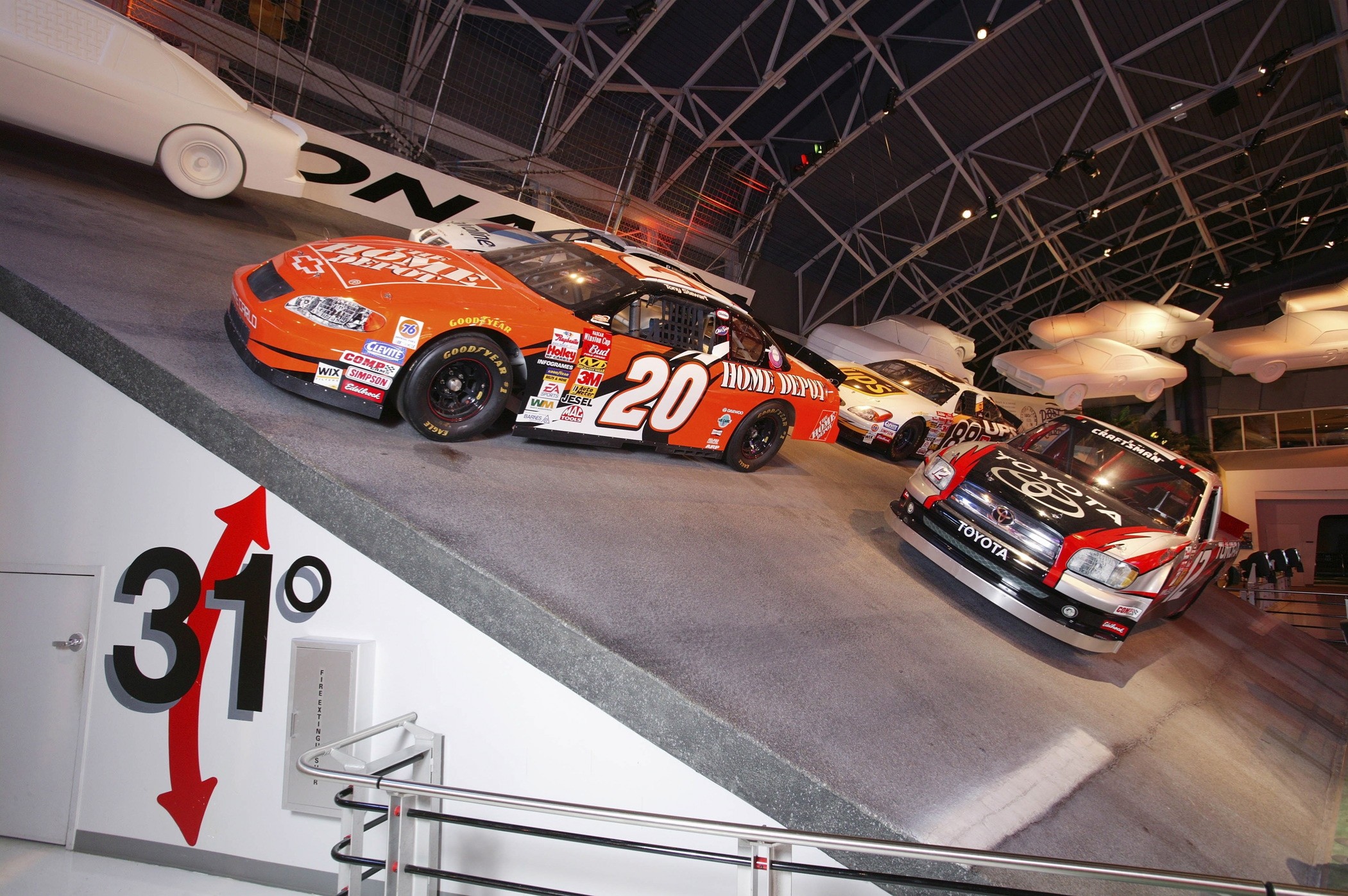
The tri-oval stretches 2.5 miles (4.0 km) of blisteringly fast configuration. Each of its two main corners features the famous 31-degree banking—steeper than nearly any paved motorsport surface on Earth. The front tri-oval drop to 18 degrees may seem gentle by comparison, but at speed, it feels like riding a roller coaster armed with a steering wheel.

The circuit is engineered for full-throttle combat. Drivers at Daytona don’t “take” corners—they surf them. The G-forces push down so hard that cars cling to the asphalt like suction cups. The banking compresses suspension geometry, slams the tires into the surface, and allows the draft to become an invisible weapon. Two cars linked nose-to-tail can slingshot past entire packs. Three cars can ignite chaos. Twenty cars can create a tornado made of steel, noise, and poor choices.

Add to this the infield road course—shaped and refined over decades—and Daytona becomes a place where prototypes and GT monsters wrestle through chicanes before launching back up onto the banking like fighter jets rejoining formation.

The sound is a signature.
Engines don’t roar here—they vibrate the atmosphere.
The banking traps the noise and throws it back at you like thunder.

This is a circuit that doesn’t whisper engineering. It screams it.

04

Modern Era & Current Use

Today’s Daytona is equal parts modern stadium and holy relic.

The $400-million “Daytona Rising” project transformed the grandstands into a colossal motorsport amphitheater capable of seating over 100,000 fans. It’s polished, air-conditioned, enormous—yet somehow still feels like the roughneck spirit of 1959 never left the building.

The Daytona 500 remains America’s Super Bowl of speed: a season-opening absurdity where tension and horsepower collide in 3-wide packs at 300 km/h. Every February, Daytona becomes the center of the racing universe, a place where victory is immortal and defeat can be seconds—or inches—away.

Endurance racing thrives too. The Rolex 24 has become the global New Year’s celebration for motorsport purists. You get hypercars sharing pit lane with tire-smoking GT bruisers, all of them dancing around the banking under floodlights so bright they make midnight feel like noon.

MotoAmerica and superbikes have also carved their history into the asphalt. Riders describe Daytona as “terrifyingly addictive,” which is biker language for “I probably shouldn’t love this as much as I do.”

Testing, club events, and driving schools fill the gaps between headline races. Even on quiet days, Daytona has presence. The grandstands watch you like a silent giant. The wind carries the ghosts of engines. The circuit feels alive.

And always—always—those bankings stand tall, daring someone new to challenge them.

Corners

01

Daytona’s Turn 1–2 high banks are the legendary opening sweep of the tri-oval, rising to a massive 31 degrees of banking—so steep that a person can barely stand on them without sliding down.

These turns are designed to let stock cars carry astonishing speed, often over 300 km/h, while remaining planted through pure aerodynamic load and the centripetal force generated by the banking itself.

Entering Turn 1, drivers feel the car compress hard into the asphalt as the suspension loads up, almost like being pushed sideways into the seat. The line through Turn 2 decides the entire back-stretch run; a perfect arc slingshots the car into a long draft, while a tiny mistake leaves the driver stranded without momentum.

Because the banking is so steep, cars can run side-by-side for multiple laps, turning the section into a high-speed chess match where drafting, timing, and trust matter as much as bravery. Simply put, Turn 1–2 is the place where Daytona stops being a normal oval and becomes a physics-bending, speed-worshipping arena.

Corners

02

Porsche VS BMW in "F1 movie"

The Porsche vs BMW sequence in the F1 movie stands out because it blends real racing physics with sharp character drama.

Both cars behave according to their true engineering DNA—Porsche stable and precise, BMW aggressive with explosive braking zones—so every move feels intentional, not cinematic fantasy. Joseph Kosinski’s filming style intensifies this realism: low-mounted IMAX cameras, brutal wind noise, real-speed passes, and cockpit vibration make you feel strapped to the chassis.

The sound design is equally fierce, capturing tail-wind turbulence, tire scrub, and the metallic bite of ABS under pressure. But the real brilliance is emotional: the chase becomes a psychological duel, each driver probing, intimidating, and counterattacking. It’s cleaner, harder, and more human than typical Hollywood racing.

Corners

03

🥇 Turn 1 – The Drop Zone

Turn 1 at Daytona is where speed, courage, and physics collide in the most violent handshake imaginable. Drivers arrive from the tri-oval front stretch at nearly 300 km/h, the draft stretching and compressing the pack like elastic. Then the world suddenly tilts: the 31-degree banking rises ahead like a dark wall of asphalt.

The moment the car drops into the arc, the suspension compresses hard, loading the chassis with a force that feels almost unnatural. Inside the cockpit, a driver’s peripheral vision narrows as the G-force pushes them deep into the seat, demanding absolute commitment to a single chosen line. Lift the throttle even slightly, and momentum evaporates. Miss the entry by a meter, and you’re skating up the wall. Turn 1 punishes hesitation, rewards precision, and transforms the entire field into a single high-speed organism where individual decisions ripple outward instantly. It is the most intimidating point of the circuit, the one spot where even veterans feel their heartbeat change. Daytona starts here—not on the grid, not on the banking, but in this split second when drivers choose bravery over doubt and dive into the most iconic superspeedway opening corner in American racing.

05

Why Daytona Endures

In a world obsessed with analytics, wind tunnels, and surgical precision, Daytona remains gloriously, stubbornly raw. This track doesn’t ask if you have the best downforce package.
It asks if you have courage. It is one of the few places left where the slipstream is a double-edged sword, where teamwork can instantly become treachery, and where one ill-timed twitch of the steering wheel can transform 20 cars into a scrapyard with momentum. But Daytona is more than danger. It holds memory.

It holds France Sr.’s dream.
Pearson’s victory crawl.
Petty’s fist pump.
Earnhardt’s triumph and tragedy.
Andretti’s endurance.
Haywood’s mastery.
Alonso’s global spotlight.

It holds the roar of crowds. The smell of burnt rubber baked under Florida sun. The echo of cars screaming into turn three. The hum of generators in the infield at 3 a.m. during the Rolex 24. The whispered legends told by mechanics leaning against pit wall at dawn. Daytona is not just a track; it’s a story still being written.

A story of human stubbornness against physics.
A story of men and women chasing something faster than fear.
A story of machines that touch the limit and sometimes tumble past it.

And perhaps that is why Daytona still matters today—more than ever.Because this is the cathedral where speed is not calculated.
It is felt.

“At Daytona, the speed doesn’t scare you — it reminds you why you became a racer in the first place.”

-
Dale Earnhardt, American NASCAR legend