“THE WIND THAT TEACHES YOU HOW TO DRIVE”

Suzuka circuit

Scroll for more

(Continue Updating ... )

At Suzuka, sound behaves differently. Engines don’t merely roar; they carve through the air like scalpels, slicing into the stillness that blankets Mie Prefecture before sunrise. The early-morning fog clings low over the infield, drifting past Dunlop Curve as if the circuit is inhaling and exhaling. And then, in the middle of this eerie calm, a lone car exits the pits, brittle cold tyres whispering across the asphalt.
This is Suzuka—where even a warm-up lap feels like a ritual. Where drivers, engineers, and machines come to be judged not by brute speed alone, but by the depth of their understanding of physics. Suzuka doesn’t tolerate arrogance. It rewards precision, punishes hesitation, and delights in exposing any hint of overconfidence. It’s not a track where you “push.” You cooperate with it. You negotiate.

Suzuka, after all, is not a racetrack. It is a stern teacher.

  • Country & Region
  • Location
  • Year Opened
  • Circuit Long
  • Corners

Info

1
https://www.suzukacircuit.jp/eng/
Thank you! Your submission has been received!
Oops! Something went wrong while submitting the form.

01

The Birth of a Legend

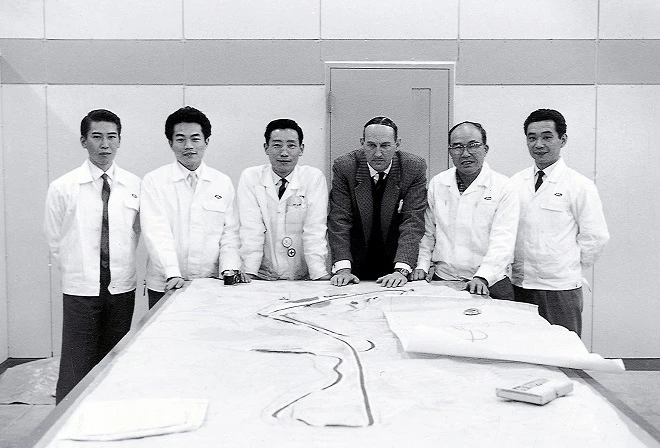
Suzuka Circuit opened its gates in 1962, the brainchild of the visionary Soichiro Honda himself. Honda didn’t want a conventional testing ground for his expanding global empire—he wanted the world’s first purpose-built figure-eight circuit. A track that would challenge his engineers and riders, and later his drivers, to understand the mathematics of speed.

He invited Dutch designer John Hugenholtz—“Hans” to most—to make it happen. Hugenholtz was already a rising star, a man who saw racetrack layouts the way a composer sees melodies. He gave Honda exactly what he asked for: a course so intimate, so demanding, and so ruthlessly honest that its very existence shaped the identity of Honda’s motorsport culture.

Back then, Japan was redefining itself—industrially, culturally, technologically. Suzuka became a symbol of that new ambition. A place where the country could point and say, “This is how seriously we take engineering.”

It wasn’t just a proving ground. It was an announcement.

02

Iconic Moments & Heroes

Suzuka’s legends are carved not in marble but in tyre marks.

Ayrton Senna’s ghost still lingers in the Esses. Stand at the first left-right-left sequence, and you can almost hear that Honda V10 scream as he flicked the steering wheel with surgeon-level articulation. Ask any Honda engineer who was around in the late ’80s—they will tell you tales of Senna studying telemetry printouts at 2am, muttering softly in Japanese to mechanics, adjusting ride heights by millimetres, then going back out at dawn. Suzuka loved him, and he loved it back.

And then came 1989—the infamous chicane collision with Alain Prost. Much has been said about the politics, the fury, the fallout. But the more important truth is simpler: Suzuka is one of the few circuits where championship-deciding controversies feel almost inevitable. Its layout compresses rivals into conflict. Its corners demand risk. Its atmosphere invites drama.

The very next year, 1990, Senna and Prost collided again—this time at the first corner. That moment, brutal as it was, cemented Suzuka as Formula 1’s emotional theatre.

Michael Schumacher also left fingerprints all over this place. His duel with Mika Häkkinen in 2000 remains one of the purest exhibitions of rival drivers operating at the absolute peak of their abilities. Häkkinen’s overtake on Schumacher through traffic on lap 40 felt like watching two chess grandmasters who’d grown bored of calculation and decided to settle it with swords.

Even in modern times, Suzuka keeps producing poetry and heartbreak. Ask Sebastian Vettel. Ask Lewis Hamilton. Ask Max Verstappen. Each has danced with this track, and each walked away changed.

03

Engineering & Design DNA

Suzuka is a driver’s circuit in the purest sense. Every corner flows into the next like a sentence written by someone who refuses to use punctuation.

The “Esses” demand rhythm. Not aggression, but tempo. You cannot force your way through—try that, and the car will simply drift wide by the second left-hander, ruining the whole sequence.

Dunlop Curve looks harmless and is anything but. It’s an uphill, blind, tightening radius sweep that amplifies every mistake made in the Esses.

Degner 1 and 2 are physics exams. Take the first one a fraction too hot, and the gravel awaits. Undershoot the second? You lose momentum for the entire run to the hairpin.

The long right-hand hairpin is deceptive. Drivers who brake too late ruin their tyres; drivers who brake too early ruin their lap.

And then there’s Spoon Curve. Spoon is Suzuka’s lighthouse—two halves of a corner that demand opposite driving philosophies. The first is patient and measured. The second is hungry and explosive. Master Spoon, and you master Suzuka.

But nothing—nothing—defines this track like 130R.

A corner that used to terrify. A corner that required conviction, courage, and a complete lack of second thoughts. The old 130R was a temple to bravery; the reprofiled modern version is still monstrous, still capable of revealing a soul. Even in modern F1 machinery, it commands respect. Every driver will swear they’re flat through it—but telemetry always tells the truth.

And above all of this, Suzuka’s most famous trait: the figure-eight layout. The only one like it in Formula 1. A design that gives the circuit perfect balance: clockwise and anti-clockwise forces, lefts and rights, elevation changes that feel organic rather than manufactured. This layout is why Suzuka feels alive beneath you. It’s why the kerbs vibrate differently, why the cambers feel sympathetic or antagonistic depending on your line.

Suzuka is an engineer’s playground and a mechanic’s confession booth. A single misjudged setup choice—rear wing angle, differential preload, anti-roll bar stiffness—and the track will bleed you dry.
04

Modern Era & Current Use

Today, Suzuka remains one of Formula 1’s crown jewels. Not just because it’s challenging, but because it’s loved. The Japanese fans are unparalleled—turning race week into a respectful, passionate, almost spiritual pilgrimage. You see grandstands full of hand-made helmets, obsessive cosplay, tiny children wearing full race suits, and octogenarians waving Honda flags from seats they’ve held for decades.

The Ferris wheel still turns, just as it did in the ’80s. The circuit still smells of barbecued food and gasoline mist. Even with extensive safety updates, the place retains its old soul, its willingness to test the character of a driver.

Outside F1, Suzuka hosts Super GT, Super Formula, motorcycles, and endless testing. GT500 cars look born for this track. Fire-breathing silhouettes thundering through 130R at sunset is one of the most beautiful sights in motorsport. And when the rain arrives—as it often does—Suzuka transforms from demanding to biblical.

Engineers obsess over aero balance. Teams prepare three rain strategies. Drivers rehearse mental models for water flow and unseen puddles. Suzuka in the wet is like playing a grand piano while someone tilts the floor.

It is as wonderful as it is cruel.

Corners

01

1. The S-Curves (Turns 3–7)

The S-Curves are Suzuka’s signature rhythm section, a flowing sequence that exposes a driver’s precision like nowhere else. Each corner feeds instantly into the next, demanding perfect weight transfer and micro-adjustments at high speed. There’s no room for hesitation; a mistake at Turn 3 becomes a disaster by Turn 6. In qualifying trim, the car is on a knife edge, dancing between understeer and oversteer while the driver fights to maintain momentum. In race conditions, tyre wear and fuel load turn the section into a delicate balancing act. It’s the kind of place where elite drivers look effortless and everyone else looks busy. Ask veterans, and they’ll all say the same: if the S-Curves feel right, the whole lap feels right. If they don’t, your lap is already dead. Suzuka starts here—not on the main straight, but inside this hypnotic left-right ballet.

Corners

02

2. Degner Curve (Turns 8–9)

The Degners are two deceptively compact bends that demand absolute commitment. The first is a fast, blind right-hander that punishes the slightest misjudgment; a few centimetres off line sends you straight into the gravel. The second Degner is even trickier—tight, technical, and made worse by braking on a slight incline. Together, they form a brutal rhythm check immediately after the flowing Esses. The transition from fluid cornering to razor-sharp precision is what makes this section so unforgiving. Drivers must hit the apex of Turn 8 with millimetre accuracy, settle the car instantly, and fire into Turn 9 without overcooking the exit. In wet conditions, this becomes one of the most terrifying spots on the entire F1 calendar. Many famous laps have been lost here, and many great drivers have admitted that a clean Degner run feels like surviving a small storm.

Corners

03

3. The Hairpin (Turn 11)

Suzuka’s Hairpin looks simple on paper, but in reality it’s a test of discipline. Drivers arrive after a fast downhill right-hander, carrying more speed than they want. The braking zone is awkward and slightly curved, forcing them to trail-brake while still rotating the car. Turn in too early and you compromise the exit; turn in too late and the front tyres slide hopelessly wide. The radius tightens subtly midway through, punishing anyone who commits too eagerly. But get it right, and the reward is immense—clean exit traction leads to a full-throttle blast toward Spoon Curve. The corner has produced overtakes that are both bold and intelligent, especially in series like Super GT, where cars can stay side-by-side without murdering tyres. The Hairpin is a reminder that Suzuka isn’t just fast; it knows how to slow you down in the cleverest, most demanding ways.

05

A Reflective Conclusion: Why Suzuka Endures

Because Suzuka is honest.

It doesn’t care about politics, budgets, or aerodynamics raised to the power of 11. It cares about lines. About throttle application. About commitment. About technique.

Circuits like Monza flatter engines. Circuits like Monaco flatter precision. Circuits like Spa flatter bravery.
But Suzuka? Suzuka flatters nothing.

It simply reveals.
It reveals whether a champion deserves the word.
It reveals whether an engineer understands the language of mechanical grip.
It reveals whether a team can synchronize driver, setup, weather, and strategy into something greater than the sum of their data.

Suzuka is living proof that the most memorable racetracks are not always the biggest, nor the fastest, nor the most expensive. They are the ones built with purpose, crafted with soul, and maintained with reverence.

And this one—this ribbon of asphalt twisting through the peaceful Japanese countryside—is a place where drivers come not just to race, but to understand themselves.

Suzuka remains legendary because it teaches you how to drive—and never stops teaching.

“In Suzuka, the car never lies. If you are not honest with yourself, the track will punish you first.”
-

Satoru Nakajima, Formula 1, Japan’s pioneering F1 driver