Where the Green Hell Tests the Courage of Every Machine and Every Soul

Nürburgring

Scroll for more

There is a particular kind of morning light that falls over the Eifel forest—a pale, milky glow that barely filters through the mist, as though even the sun is unsure it wants to witness what happens here. Before the engines start and before the marshals slip on their headsets, the air hangs heavy and cold.

Then someone fires up a flat-six, or a V8, or something terrifyingly handmade, and the forest exhales. The sound rolls across the hills like a war drum. This place is not a circuit. It is a threshold. Everyone who drives here steps across it knowing the Ring does not care who they are, what they’ve achieved, or who they hope to impress. It only measures nerve.

  • Country & Region
    Germany
  • Location
    Nürburg, Rhineland-Palatinate
  • Year Opened
    1927
  • Circuit Long
    22.835 km
  • Corners
    ~160

Info

Nürburgring GmbH & Co. KG
Otto Creutz (original layout)
7 : 42.92 (Jacky Ickx, 1969)
~0.8 km (approx main straight)
Clockwise
-
1
~300 m
https://www.nuerburgring.de/
Thank you! Your submission has been received!
Oops! Something went wrong while submitting the form.

01

The story starts in 1927, when Germany decided it needed a place to push its cars and its courage to the limit. Dr. Otto Creutz, an engineer of both ambition and audacity, believed a proper circuit should replicate the chaos of natural terrain. No smooth, gentlemanly curves. No pampered geometry. He wanted elevation, fear, and unpredictability. And he got all of it. When the Nordschleife opened, measuring a biblical 22.8 kilometres through the mountains of the Eifel, it quickly became less a circuit and more an ordeal.
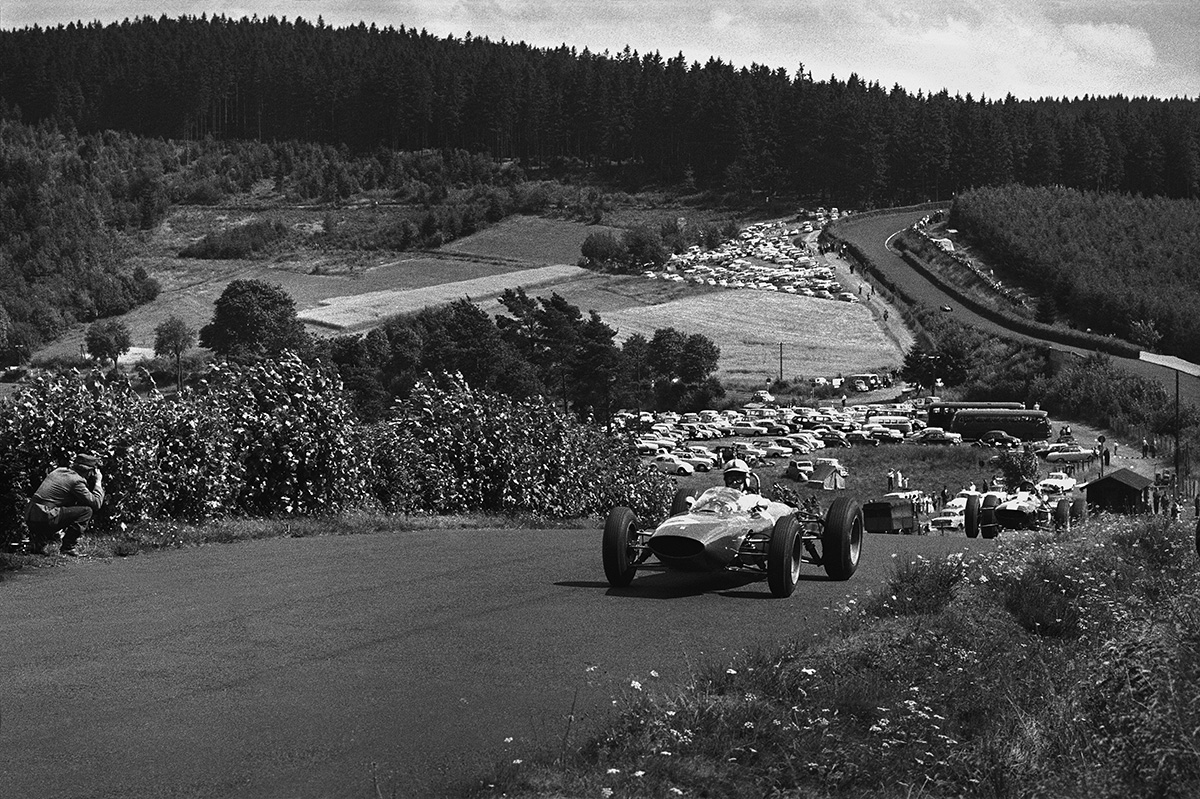
The early years were cruel, even by the standards of motorsport’s wild adolescence. Engines overheated. Brakes surrendered. Drivers would start a lap feeling confident and finish with a thousand-yard stare. The Nürburgring wasn’t designed to reward talent—it was designed to reveal it. Those who survived the experience spoke of it the way mountaineers speak of storms: equal parts awe and trauma.

02

Some circuits produce famous races. The Nürburgring produces legends.

Juan Manuel Fangio’s 1957 performance, often called the greatest lap in history, is still studied like biblical scripture. Having lost time in a long pit stop, Fangio hurled the Maserati 250F around the circuit with a controlled madness that defied the era’s physics. He overtook both Ferraris, won the race, and collapsed in the pits from exhaustion. “I never drove that fast again,” he admitted, which tells you everything you need to know about the place.

Jackie Stewart gave the Ring its eternal nickname—“The Green Hell”—after winning there in fog so thick marshals could barely see each other. Meanwhile, Niki Lauda’s 1976 crash carved the track’s darkest chapter into motorsport history. His wreck, his fire, his survival—these moments permanently burned the Nordschleife into racing mythology. Every driver who walks the paddock today, no matter how modern the equipment, carries some reverence for the ghosts who came before.

03

Trying to describe the Nordschleife with numbers—154 corners, nearly 300 metres of elevation change—misses the point. The place feels alive. Corners appear and dissolve with a kind of mischievous unpredictability. The Karussell drops drivers into a concrete trench that chatters through the suspension like an accusation. The high-speed left at Schwedenkreuz demands commitment bordering on irrationality. Pflanzgarten turns the bravest into believers as the car goes light over a crest that looks, from inside the cockpit, like a decision you might regret.

The elevation change is not gentle. It hurls cars upward, plunges them down ravines, swings them sideways, and occasionally threatens to throw them into the trees. The camber shifts under you. The wind pushes you. Even the temperature varies around the circuit, making tyre management a psychological puzzle. One moment you’re flat-out. The next you’re trying to remember if your health insurance covers “driver error in the Eifel forest.”

No amount of simulation or coaching prepares you for what the Ring does to your senses. Your vision compresses. Your hands tighten. Your brain-pan starts running faster than your vocabulary. Even professional drivers admit that a perfect lap here is less “achieved” and more “survived with style.”

04

Today the Nürburgring is many things at once: a racetrack, a public road, a shrine, a laboratory, and occasionally a playground for people who probably shouldn’t be here. Manufacturers use it as an automotive crucible. Camouflaged prototypes scream around the circuit at the limit of design and sanity, engineers studying every twitch like surgeons watching vital signs.

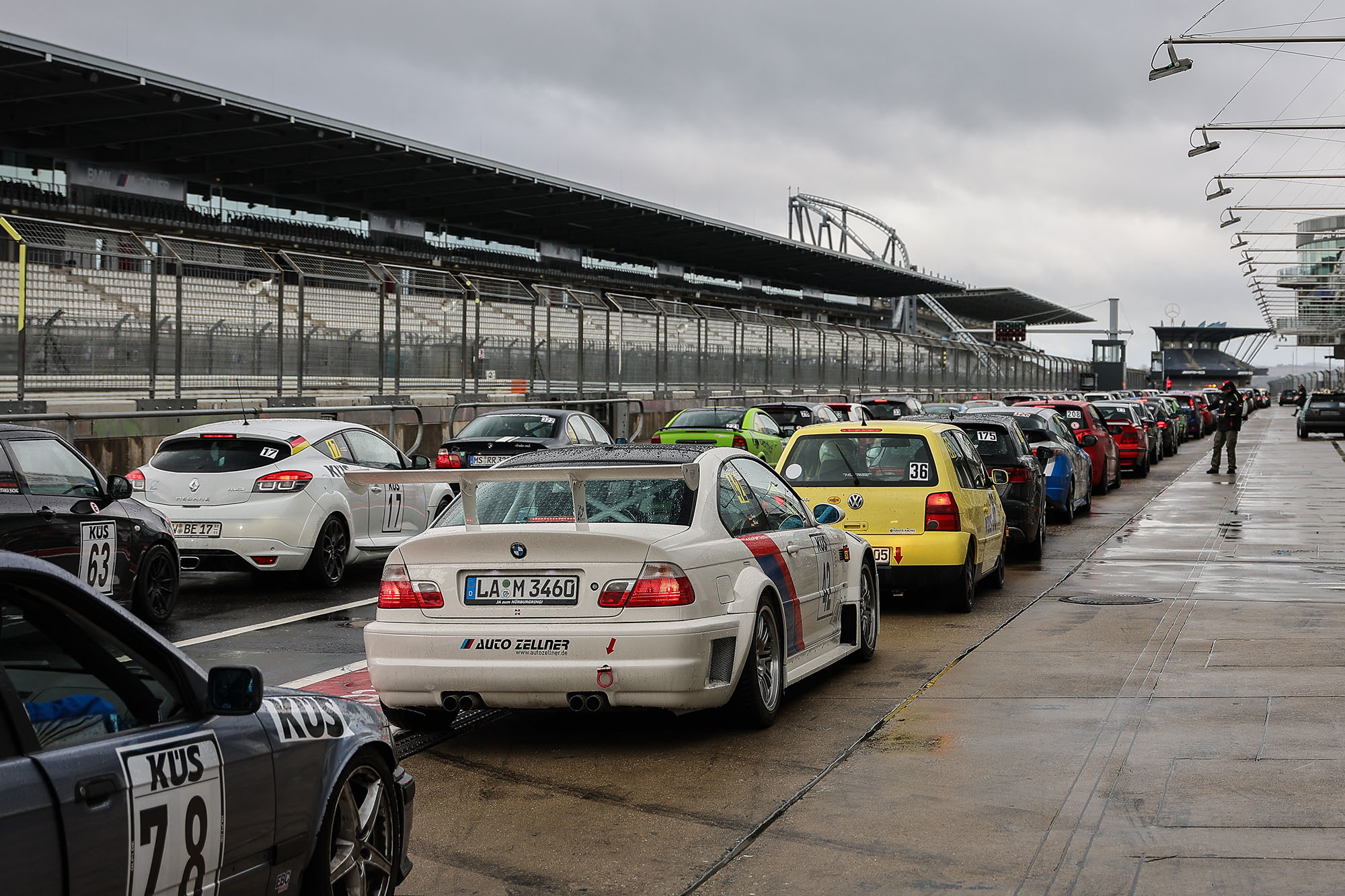
Then comes “Touristenfahrten,” the public sessions when anyone with a license, and occasionally questionable judgement, can buy a ticket and drive the same surface that humbled Fangio and Stewart. Rental Swifts buzz around like caffeinated insects while GT3 RSs pass them with the closing speed of guided missiles. Everyone here is living a shared dream, though some leave with a bill from the Armco repair department.

The 24 Hours Nürburgring remains one of the calendar’s most vicious endurance events. Rain, fog, hail, and sunshine often rotate within a single lap. Drivers talk about hallucinations, about muscle fatigue so intense that the car begins to feel like a separate personality. And still, year after year, they return. Because this isn’t a race—it’s a pilgrimage.

The circuit has been renovated and modernised, but none of the updates dilute its essence. Safety barriers grow taller, but fear remains exactly the same height.

Corners

01

Caracciola-Karussell

Type: Steeply banked 180° concrete bowl
Approx. Speed: 60–90 km/h
Why it’s iconic:

  • The most visually recognizable corner in world motorsport.
  • Its concrete slabs were originally built for drainage and stability, not racing.
  • The banking creates massive vertical load, pinning the car down.
  • If you enter too early or too late, the concrete joint throws the car out violently.

Historical notes:

  • Named after Rudolf Caracciola, Mercedes legend, who used this inside line to dominate pre-war races.
  • Drivers say the Kerbs here “vibrate your teeth fillings loose.”
  • Even modern GT3 cars must pick a precise entry angle; any lap record attempt succeeds or dies here.

Why it matters:
Pure car control — banking, grip shift, suspension compression — all in one visually terrifying moment.

Corners

02

Flugplatz (“The Airfield”)

Type: High-speed crest into left sweep
Approx. Speed: 200–260+ km/h
Why it’s dangerous:

  • A violent crest that removes 60–80% of downforce for a split second.
  • Older Group C cars and DTM machines would literally jump.
  • Drivers are still at full throttle, placing the car at the limit of aerodynamic balance.

Anecdotes:

  • Many pros describe Flugplatz as the point where you “test your soul.”
  • The compressed landing immediately loads the suspension before you must turn left—zero recovery time.
  • If the car lands even 10 cm off ideal alignment, the left turn becomes lethal.

Why it matters:
It’s the perfect representation of Nordschleife chaos: speed + elevation + zero margin.

Corners

03

Schwedenkreuz (“Swedish Cross”)

Type: Ultra-fast left kink
Approx. Speed: 230–270 km/h
Why drivers fear it:

  • It is blind, still downhill, and taken almost flat.
  • One of the most common fatal crash sites in track days and races.
  • Guardrails are close; any slide means instant impact.

Technical notes:

  • After the Flugplatz landing, the car still hasn’t fully stabilized.
  • The corner forces aerodynamic load and mechanical grip to work together; if one fails, it’s over.
  • Braking for the following downhill right (Aremberg) must begin while the car is still loaded from the kink.

Why it matters:
The ultimate test of nerve — only complete trust in the car’s aero will get you through cleanly.

05

The Nürburgring endures not because it is dangerous, though danger is certainly part of its charm. It endures because it is honest. It does not grade on a curve, it does not flatter mediocre effort, and it does not pretend to be something it isn’t. Every lap is a truth serum. It reveals who you are, how much nerve you have, and whether you’re ready to meet the part of yourself that doesn’t bluff.

Driving here—driving well—changes people. You step out of the car with knees shaking and heart hammering, but also with a clarity you didn’t know you were missing. The Ring doesn’t make you feel like a hero. It makes you feel human. And that’s far more valuable.

In the Eifel forest, courage is an exhaustible resource. Discipline is not. That’s why the Nürburgring remains what it has always been: the ultimate test of spirit, engineering, and the immortal desire to find out how close you can get to the edge without tumbling into it.

Because here, on this violent ribbon of asphalt, bravery isn’t a trait. It’s a currency—and the Ring charges interest.

“You cannot describe the Nürburgring. You can only drive it. And when you do, it tells you exactly what kind of driver you really are.”

-

Jackie Stewart, Scottish Formula One World Champion