A tailored American shadow with a V8 heartbeat, where Detroit learned that true swagger sometimes arrives with less chrome and more silence.
On a damp evening outside Claridge’s in London, Bill Mitchell saw a Rolls-Royce beneath the hotel lights and had one of those thoughts that occasionally justify an entire design department: lower it, sharpen it, and there was the silhouette. What emerged in 1963 was the Buick Riviera, a car built in America but apparently dressed for dinner somewhere considerably more expensive.
Mitchell wanted a personal luxury coupé with Rolls-Royce formality and Ferrari tension, while designer Ned Nickles helped turn the idea into GM’s XP-715 project. Cadillac declined it, and Buick, Oldsmobile and Pontiac were invited to compete for the proposal. Buick won partly by promising not to fiddle with the styling. This was unusually wise corporate behaviour.
The production Riviera arrived with a long bonnet, cropped tail, frameless side glass and body sides so clean they made many contemporary American cars look as if their designers had been paid by the yard of chrome. It rode on a 2,972 mm wheelbase yet avoided Detroit bulk. The roof sat low, the waistline was crisp and the vertical front-fender grilles hinted at the hidden lamps Mitchell originally wanted. Engineering said no for 1963, because engineers occasionally enjoy reminding stylists who has to make things work in winter.
Power was considerably less restrained. The standard 1963 Wildcat 445 was Buick’s 401 cu in, 6,572 cc “Nailhead” V8, producing 325 hp and 445 lb-ft. An optional 425 cu in, 6,965 cc version produced 340 hp and 465 lb-ft. These were not delicate, high-revving engines. Their small, vertically arranged valves gave the Nailhead its nickname and its personality: huge low-speed torque delivered with the certainty of a large man moving a sofa without asking for help.
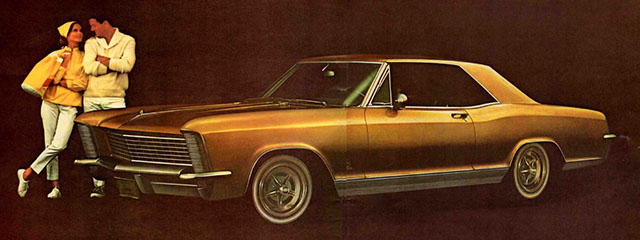
All of it went to the rear wheels. The 1963 Riviera used Buick’s two-speed automatic, replaced for 1964 by the three-speed Super Turbine 400. That year the 425 became standard and a dual-carburettor Super Wildcat arrived with 360 hp. Two four-barrel carburettors on a luxury coupé sounds excessive until you remember this was 1960s America, when moderation was regarded as something Europeans did because their roads were narrow.
The chassis was more thoughtful than the boulevard image suggested. An X-type frame saved weight and allowed a lower body, with unequal-length control arms and coils at the front and a coil-sprung live rear axle located by links and a Panhard rod. The Riviera was firmer and more controlled than Buick’s full-size cruisers. At roughly 1,800 kg depending on specification, it was hardly a Lotus, yet it carried its mass with surprising composure.
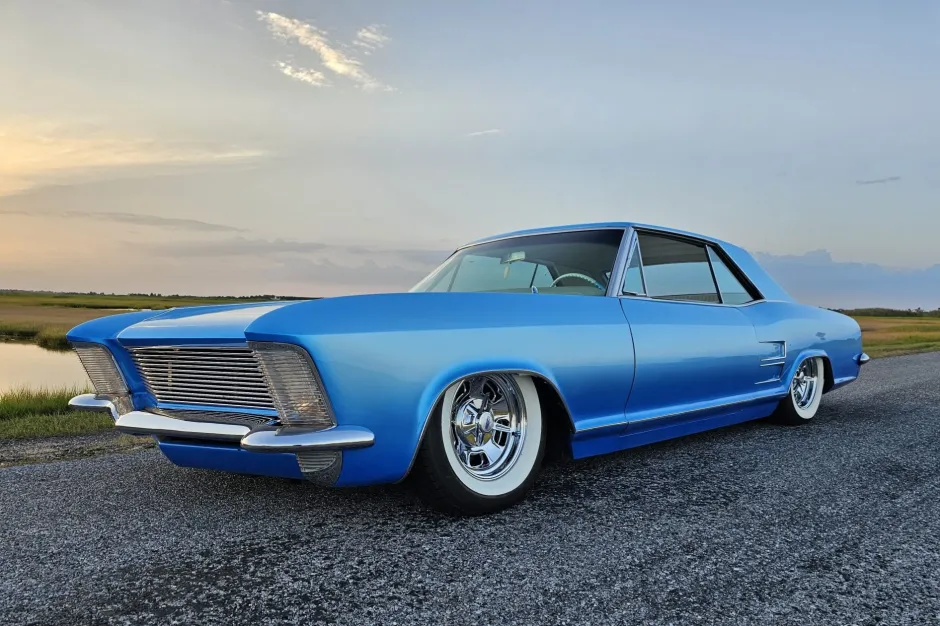
Then came 1965, and Mitchell finally got his headlights. Electrically operated clamshell doors appeared in the front fenders, opening to reveal vertically stacked lamps. The rear was cleaned up, fake quarter-panel scoops disappeared and the taillamps moved into the bumper. It completed the design so convincingly that earlier cars suddenly looked like preliminary sketches, which is rather unfair because they were already magnificent.
Buick also introduced the Riviera Gran Sport. Its dual-quad 425 Super Wildcat made 360 hp and 465 lb-ft, backed by a recalibrated Super Turbine 400, 3.42 gearing and limited-slip differential. Only 3,354 of the 34,586 Rivieras built for 1965 received the GS package. It was Buick discovering muscle cars while refusing to loosen its tie.
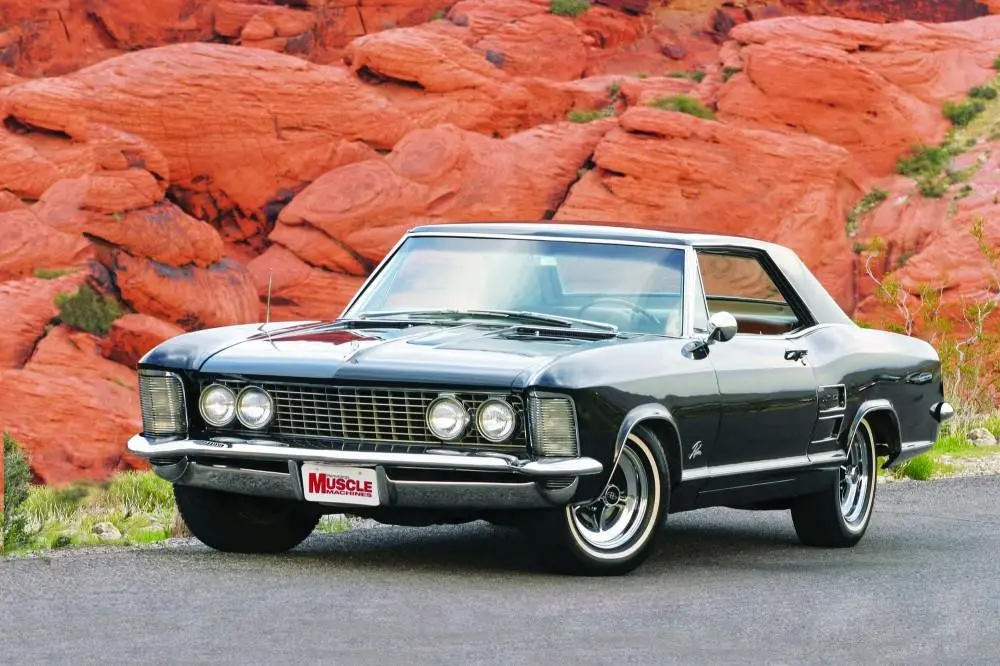
Across 1963–65, 112,244 first-generation Rivieras were produced. Their importance runs deeper than rarity. The Riviera proved Detroit could create luxury through proportion rather than decoration. It did not need tailfins, acres of brightwork or a grille resembling municipal architecture. Its authority came from tension: formal but slightly sinister, luxurious but never soft.
Its greatest design achievement is not what it added to American luxury, but what it persuaded America to stop adding. The car’s Signature Line is simple: the Riviera made restraint look expensive.
Today the finest examples, particularly 1965 Gran Sports, are serious collector cars, but they remain usable enough to remind owners what they were designed to do. You sit low behind that long bonnet, feed torque through an automatic gearbox and watch the world arrive with almost indecent calm. Nobody needs to know you have nearly seven litres of V8 ahead of you. The exhaust will eventually explain.
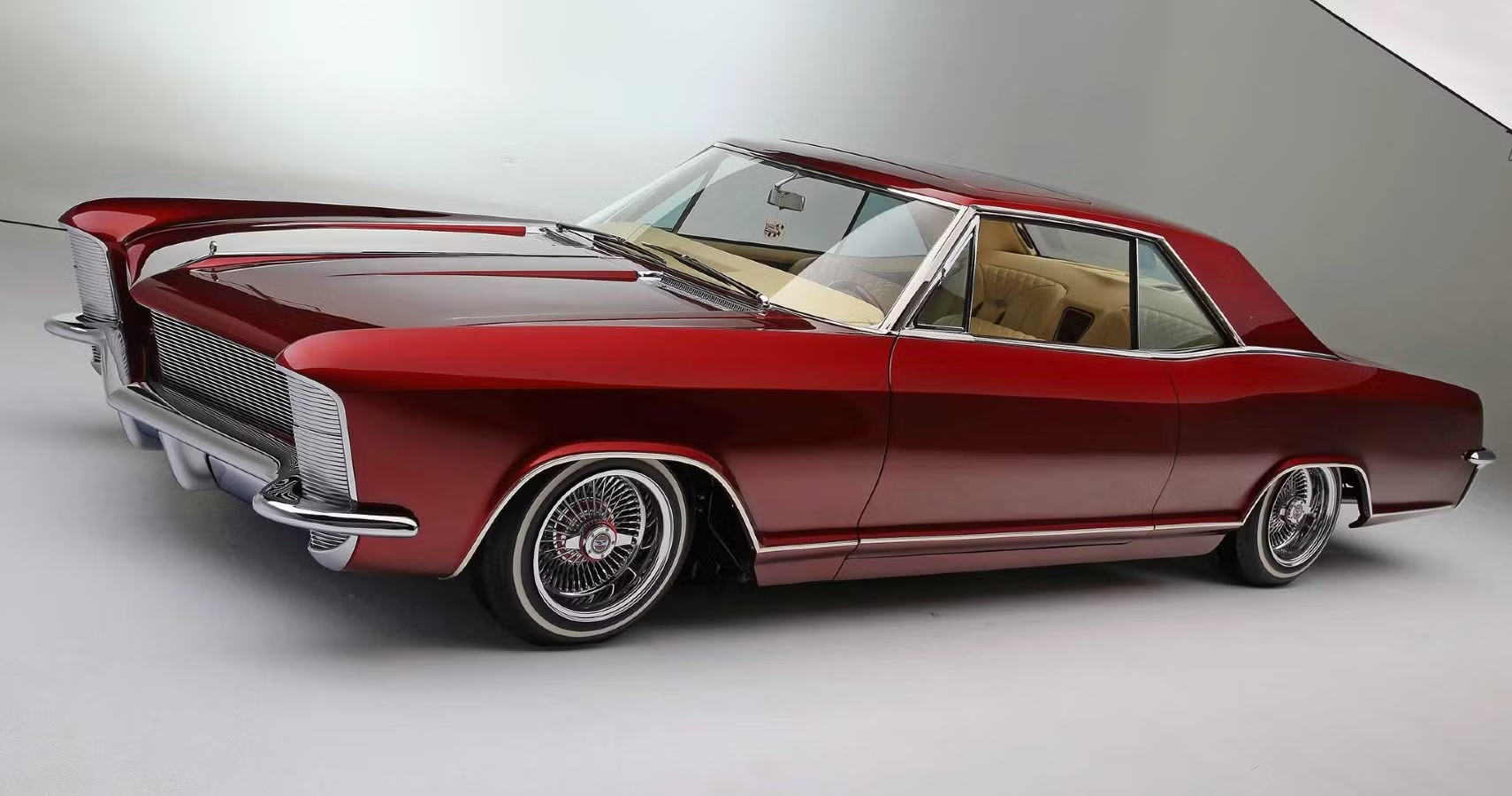
The 1963–65 Riviera therefore represents a rare American moment when confidence replaced spectacle. Born from a foggy London observation, shaped by some of GM’s finest designers and powered by engines from an age when cubic inches solved most philosophical disputes, it still looks composed, dangerous and beautifully underdressed — proof that sometimes the boldest thing Detroit can do is know when to stop.


