

Lamborghini Countach 5000 Quattrovalvole 1988
Posted on
5/9/2026
by
Cinematic Italian supercar history with precise engineering detail, dry humour, confident museum authority, and reverence for radical design without mistaking legend for effortless usability.
By 1988, the Lamborghini Countach had become less a car than a geometric threat to ordinary life. This entry focuses on the Countach 5000 Quattrovalvole—the final, four-valve evolution of the original Countach line, rather than the 25th Anniversary edition also introduced in 1988. It is the version where the poster fantasy acquired the mechanical muscle to match.
At its centre sits a 5,167 cc naturally aspirated V12, mounted longitudinally behind the cabin and feeding the rear wheels through a five-speed manual gearbox. In European carburetted form it produced 455 CV at 7,000 rpm, a suitably theatrical number for a machine that looks as though it should require clearance from air-traffic control before entering a car park. Four valves per cylinder gave the old Bizzarrini-derived V12 more breath at high revs; the engine-cover hump was the visual consequence of fitting it in. On this Lamborghini, packaging practicality was never allowed to interrupt the silhouette.
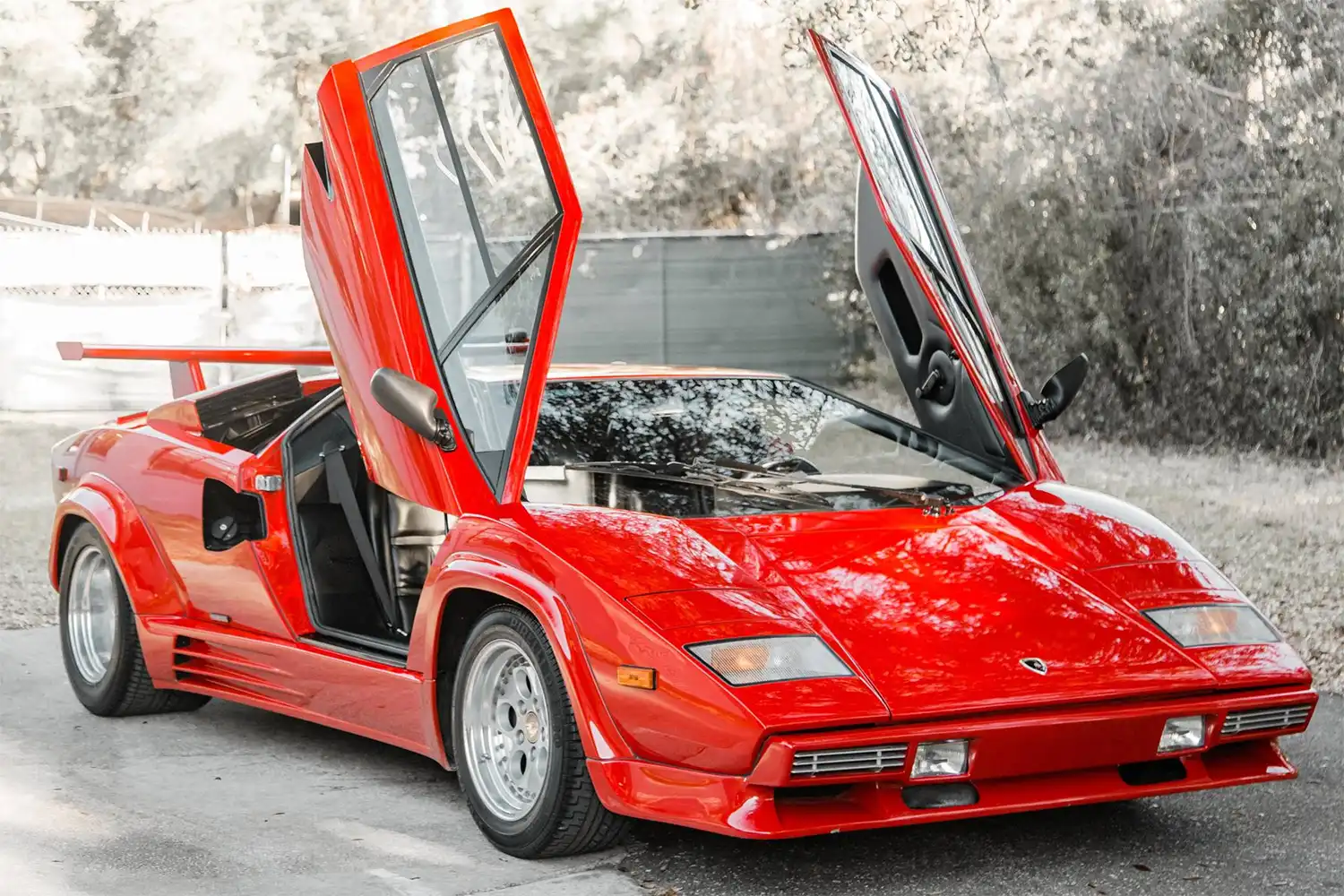
Marcello Gandini’s shape remains startling because it does not apologise for being difficult. The roofline is low, the windscreen is steep, the rear tyres are outrageously broad, and the scissor doors turn every arrival into a small performance. In 1988, the addition of pronounced side skirts made the Countach look even lower and more planted—as though it had already decided that the horizon was optional.
Drive it with modern expectations and the Countach can seem wilfully inconvenient. Visibility is compromised, cabin heat is part of the personality, and the steering asks for a proper conversation rather than a casual suggestion. But these are not flaws in the usual sense. They are reminders that this car was conceived before supercars learned to behave politely. It demands attention because it was designed to reward commitment.
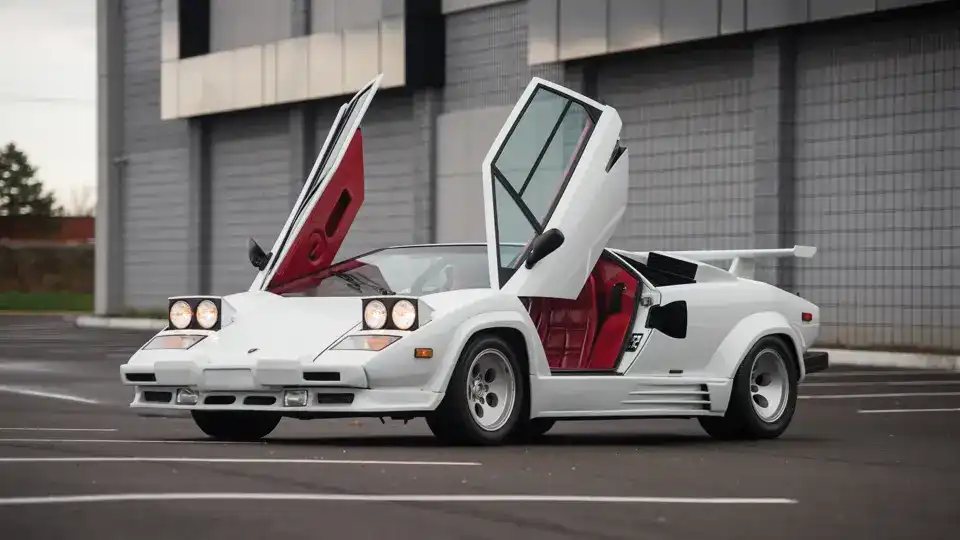
The 5000 Quattrovalvole sits at a particularly important point in Lamborghini history. It was the final high-development expression of the Countach’s original idea: a hand-built, mid-engined V12 machine whose design arrived before the world had decided it was ready. By the late 1980s, rivals had become faster, more refined and more aerodynamic. None, however, could make a school notebook feel like a launchpad in quite the same way.
The Countach’s name comes from a Piedmontese exclamation of amazement. That is unusually honest branding. You do not approach this Lamborghini and calmly say, “That seems well considered.” You stop, look at the wedges, ducts, wings and impossible doors, then make the sound the name has been waiting for.
The Countach 5000 Quattrovalvole is not merely an icon of excess. It is the moment excess became a design language—and spoke Italian with a V12 accent.