A Ferrari-boned V12 racing homologation special stretched into a magnificent blue-and-white missile that returned Maserati to international competition and promptly started collecting trophies.
Modena, 2004. Maserati had spent nearly four decades away from top-level international GT racing, which is an awfully long time for a company whose badge is literally a weapon. So when the Trident finally returned, it did not arrive with something modest. It arrived with a five-metre-long V12 projectile called the MC12.
The road car existed for one wonderfully old-fashioned reason: homologation. Maserati wanted to race in FIA GT, and regulations required a road-going version. Thus the MC12 Stradale was born — fifty examples across 2004 and 2005, twenty-five each year — essentially making every owner an accomplice in a racing programme.
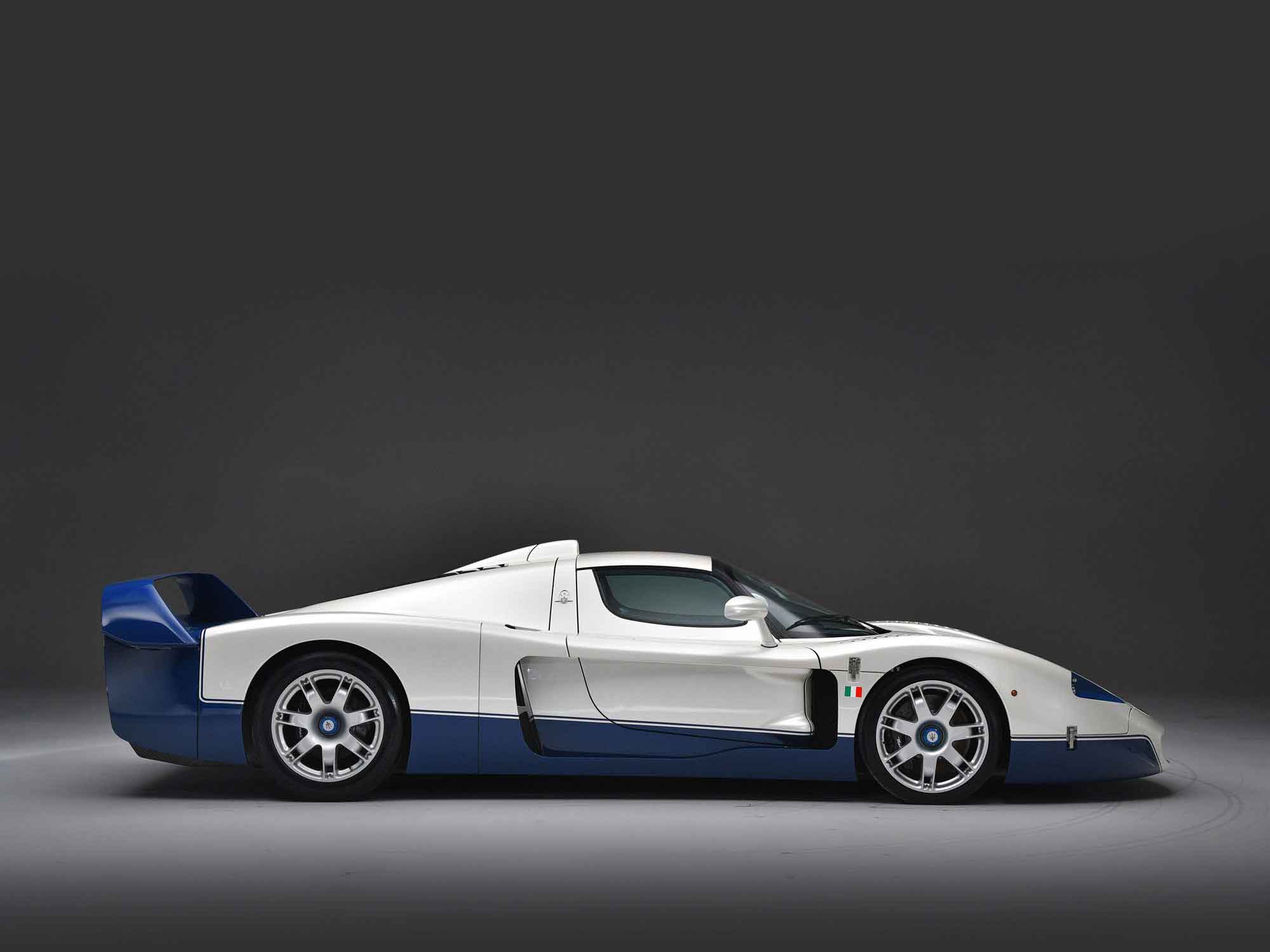
Its foundations came from the Ferrari Enzo, although calling the MC12 an Enzo in a dinner jacket rather misses the point. Maserati lengthened the wheelbase, completely changed the body, reworked the aerodynamics and softened certain aspects for high-speed stability. At 5,143 mm long and more than two metres wide, it was considerably larger than the Ferrari. Parking one in central London would require either courage or ownership of central London.
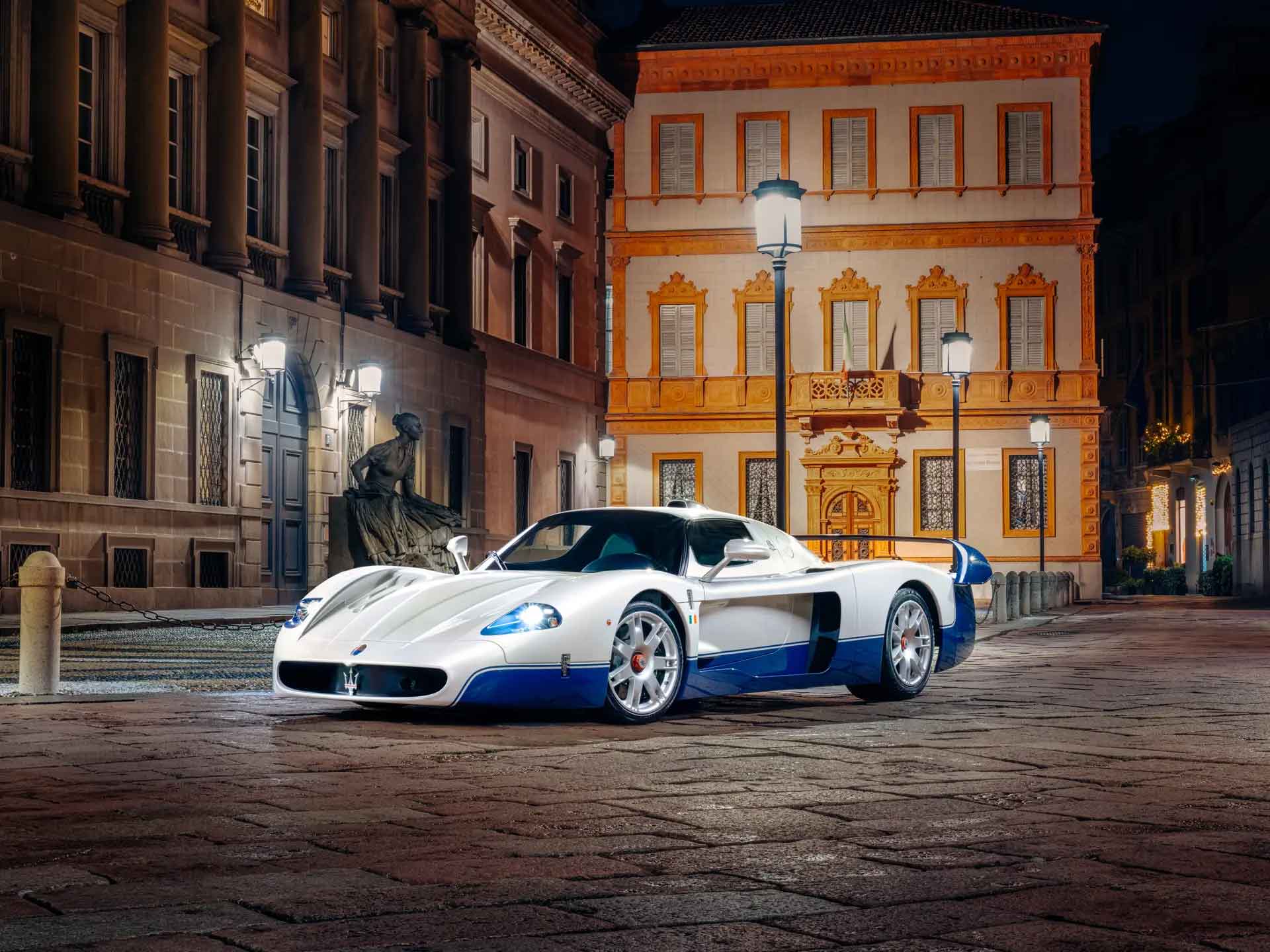
Behind the cabin sat a Ferrari-derived 5,998 cc naturally aspirated 65-degree V12 producing 630 hp at 7,500 rpm. Power reached the rear wheels through a six-speed electrohydraulic manual transaxle. There were no turbochargers, hybrid motors or electrically assisted excuses — just twelve cylinders inhaling atmosphere and converting expensive fuel into noise.
The numbers remain properly serious. Zero to 100 km/h took around 3.8 seconds, while maximum speed was 330 km/h. Curiously, the Enzo was slightly faster in a straight line. Maserati did not appear concerned. The MC12 had been shaped around racing stability rather than winning motorway Top Trumps, which is generally reassuring when the motorway has Armco and you are doing 300.
Its carbon-fibre and Nomex honeycomb monocoque kept kerb weight to 1,335 kg. The suspension used double wishbones with pushrod-operated springs and dampers, while enormous Brembo brakes dealt with the consequences. There was also a removable roof panel, although no luggage compartment of meaningful size. Apparently the engineers assumed anyone travelling in an MC12 would simply have another vehicle carrying their belongings. Sensible.
The body is where the Maserati becomes unmistakable. A vast nose, enormous side intakes, impossibly long tail and fixed rear wing make it look less like a conventional supercar than something that escaped from parc fermé. The white-and-blue paint referenced Maserati's American racing colours and the Birdcage era, giving the car a surprisingly elegant appearance despite dimensions normally associated with regional infrastructure.
And then the racing version justified everything.
The MC12 GT1 debuted in 2004 and became one of the dominant GT racers of its generation. Between 2004 and 2010, Maserati records 22 race victories, including three Spa 24 Hours wins, and 14 championship titles across drivers, teams and constructors. Andrea Bertolini and Michael Bartels became closely associated with its success, while Vitaphone Racing's blue-and-black MC12s spent several seasons making rival teams thoroughly familiar with second place.
That competition record transforms the road car. Plenty of manufacturers build limited-edition supercars and subsequently invent elaborate reasons why they are historically important. The MC12 works backwards: its racing programme created the reason first, then built the road car because the rulebook demanded paperwork with number plates.
Signature Line: the MC12 was not a road car turned into a racer; it was a racing programme temporarily inconvenienced by registration plates.
Its modern collector status reflects that purity. Only fifty Stradales exist, and in 2025 one sold for $5.2 million, setting a new auction record for the model. Yet rarity is only part of the attraction. The MC12 belongs to that increasingly extinct species of supercar whose existence was dictated by motorsport rather than market research.
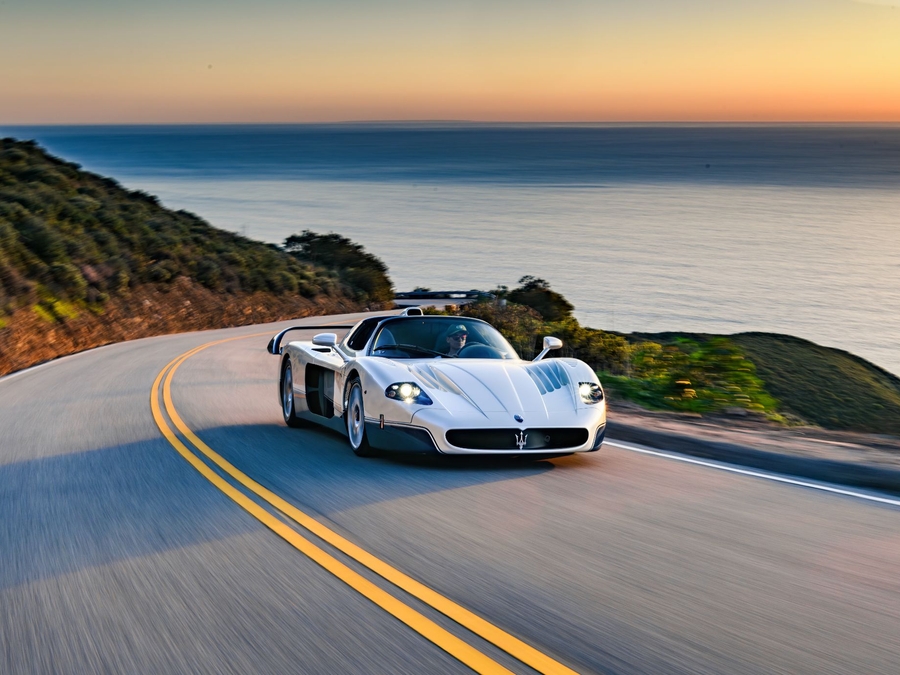
The Enzo may have supplied the bones, but Maserati gave the machine a different purpose. Longer, calmer at enormous speed and directly connected to one of the most successful GT racing campaigns of the 2000s, the MC12 became more than Maranello engineering wearing another badge.
It became the car that reminded the world what Maserati used to be — and, for six glorious years, what it could still do.


