Victory came not from avoiding every mistake, but from making fewer of them—and surviving each one better than everyone else.
Saturday afternoon at Le Mans began with Toyota buried on the seventh row, which is not where manufacturers usually place their grand statements. Cadillac had locked out the front, BMW looked sharp, Ferrari arrived carrying three consecutive victories, and the two red TR010 HYBRIDs sat 14th and 15th, appearing rather like late guests at a dinner party they had quietly planned to own by dessert.

Le Mans, fortunately, has little interest in qualifying theatre. It is a twenty-four-hour examination in which the questions change constantly, the invigilator is French weather, and several candidates eventually catch fire. The objective is not to avoid every mistake. That is impossible. The objective is to make fewer mistakes than everyone else, repair the unavoidable ones quickly and ensure the same calamity does not return wearing a different hat.
Toyota understood this from the opening hour. Rather than follow the leaders into the conventional pit sequence, the team separated its strategy from the pack, searching for clean air and a clearer route through traffic. Both TR010s moved rapidly forward, their 3.5-litre twin-turbocharged V6 engines and front-axle hybrid systems settling into the long rhythm of endurance racing. They did not charge as though victory had to be achieved before dinner. They advanced steadily, which looks less heroic on television but tends to impress the people responsible for paying for replacement bodywork.
At the front, René Rast placed the No. 20 BMW into contention with considerable authority. BMW had already shown pace at Spa and arrived in France with the confidence of a company remembering that it had once won Le Mans outright in 1999. Cadillac was faster still during sections of the race, its V-Series.Rs occupying the lead through the night. Ferrari, meanwhile, carried the weight of recent history. Three consecutive victories create confidence, but they also make everyone in the garage behave as though a fourth is merely an administrative matter. Le Mans enjoys correcting that sort of assumption.
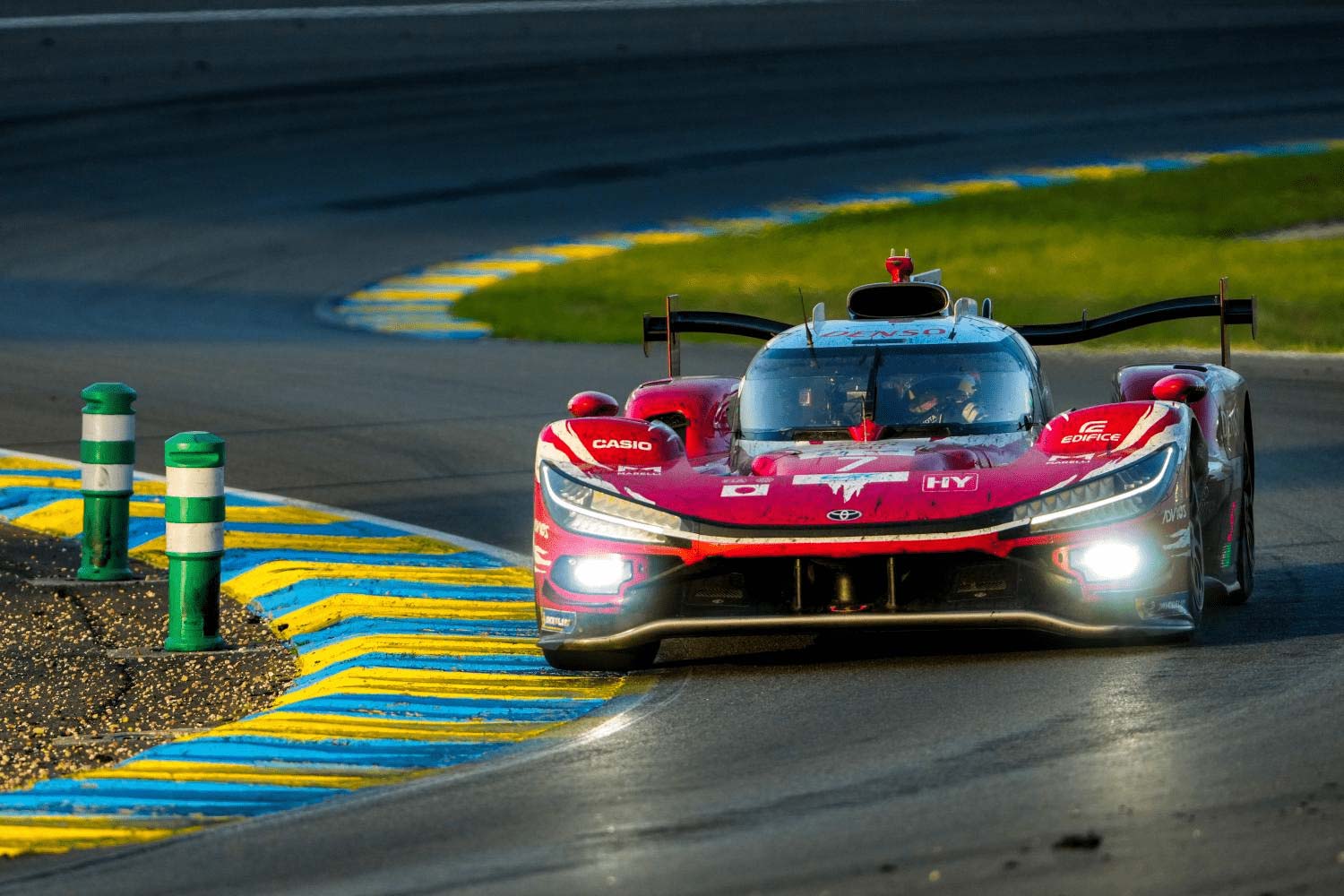
For much of the opening phase, the No. 8 Toyota appeared the stronger of the pair. Sébastien Buemi, Brendon Hartley and Ryō Hirakawa placed it firmly among the leaders as darkness swallowed the Mulsanne Straight. The No. 7 car of Mike Conway, Kamui Kobayashi and Nyck de Vries endured a more complicated evening. A slow puncture in the fourth hour cost time, followed later by a driveshaft sensor problem that dropped it down the order.
Neither issue was spectacular. There was no dramatic explosion, no wheel departing towards Normandy and no mechanic staring into the middle distance while orchestral music played. They were simply the sort of small mechanical inconveniences that quietly destroy entire races. Toyota dealt with both, returned the car to the track and continued.
That became the defining quality of the TR010. It was not flawless; flawless racing cars exist mainly in press releases. It was resilient. Every problem was treated as an interruption rather than a tragedy. At Le Mans, the winning car is rarely the one that experiences nothing unpleasant. It is the one that responds to unpleasantness without immediately arranging another example.
Cadillac discovered the difference during the night. The No. 38 car had genuine winning pace, but a power-steering failure cost seven laps and eventually forced retirement. The No. 12 Cadillac remained in the fight and led into the final quarter, only for a slow-zone infringement to produce a drive-through penalty. Emergency pit stops followed, converting a possible victory into fourth place. The machinery remained fast; the race simply kept presenting invoices.
BMW’s challenge was equally serious. The No. 20 car stayed close enough to threaten Toyota throughout the closing stages, while the pole-starting No. 15 disappeared from contention. Ferrari never found the authority of its previous three campaigns. One by one, the favourites were not beaten in a single dramatic moment but reduced by accumulated delays, penalties, failures and choices that had seemed perfectly sensible several hours earlier.
Then Sunday morning altered everything. A heavy accident involving an LMGT3 Porsche damaged the barriers and brought out the second safety-car period. The field compressed, strategies were rearranged and the wounded No. 7 Toyota suddenly found itself restored to the argument. After nearly a day of measured survival, the race became a sprint between both Toyotas, the No. 12 Cadillac and the No. 20 BMW.
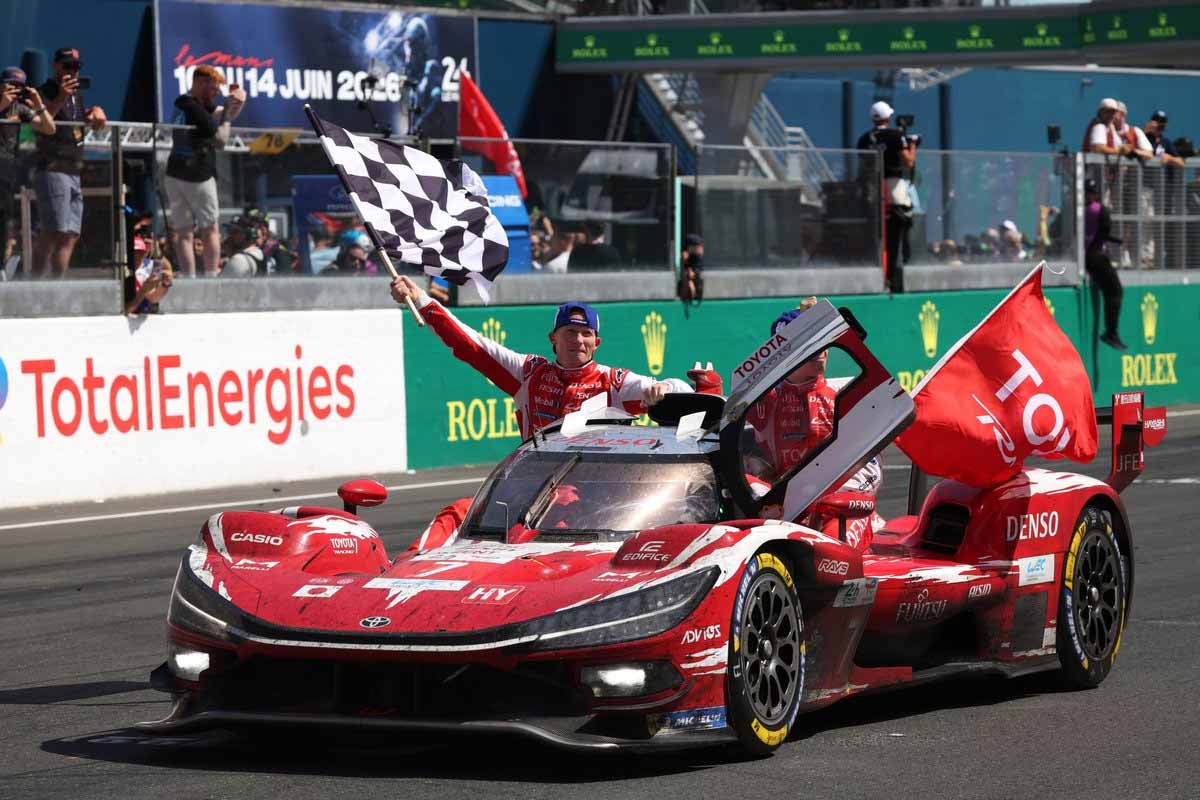
Kobayashi supplied the pace. De Vries supplied the aggression, committing to a decisive move on Norman Nato into Mulsanne Corner. It was the sort of overtake that appears brave from the grandstand and medically questionable from inside the cockpit. A late Full Course Yellow also helped the No. 7 crew, but fortune at Le Mans usually visits cars that have first completed the difficult business of remaining alive long enough to meet it.
Toyota had survived the puncture, the sensor fault and the uncertainty of the night. Now it possessed something more valuable than outright speed: a healthy racing car at the exact moment everyone stopped conserving theirs.
The final half-hour was vicious. Robin Frijns closed in aboard the No. 20 BMW, forcing Kobayashi to push through traffic with no room for hesitation. Behind them, the No. 8 Toyota and the remaining Cadillac waited for either leader to make the sort of tiny error that becomes enormous after twenty-four hours. Every braking zone felt sharpened; every slower car became a moving negotiation.
After 381 laps, Kobayashi crossed the line just 10.913 seconds ahead of BMW. The sister Toyota finished third, only 20.417 seconds from victory. An entire day of racing, thousands of gear changes and more than 5,000 kilometres had produced a winning margin shorter than the time required for a hotel lift to reconsider closing its doors.
It was Toyota’s sixth overall Le Mans victory and its first since 2022. Conway and Kobayashi earned their second triumph; de Vries took his first. More significantly, the TR010 established itself immediately. This was not merely the GR010 wearing red bodywork and a freshly approved corporate identity. It had defeated Cadillac’s speed, Ferrari’s recent dynasty and BMW’s late pressure by understanding the oldest truth of endurance racing.
**The TR010 won because it treated every mistake as survivable, but never as acceptable twice.**
Its hybrid system provided acceleration, its revised aerodynamics provided consistency and its engineers gave it the durability to remain competitive through daylight, darkness and the strange emotional territory just before dawn. Yet its greatest weapon was judgement. Toyota did not lead every hour, set fire to the timing screens or attempt to prove its courage at every corner. It simply moved forward while its rivals gradually surrendered time, machinery and opportunities.
At Le Mans, bravery gets the photographs and speed gets the headlines. Victory usually belongs to the team still behaving intelligently after everyone has been awake far too long.
-
Finnish Formula One racing driver.


