A supercharged V12 featherweight that crossed the Atlantic to embarrass racing royalty with equal parts elegance, improvisation and barely supervised madness.
In the Argentine summer of 1949, the heat sat over Buenos Aires like a heavy coat nobody had ordered. Into it rolled a tiny single-seater with exposed wheels, a narrow cockpit and twelve cylinders where moderation might otherwise have lived. The Ferrari 166 FL looked delicate enough to be posted home, yet it had crossed the Atlantic to fight Alfa Romeo, Maserati and ageing Mercedes machinery on fast, uneven circuits where straw bales were regarded as advanced safety technology.
Its origins lay in Enzo Ferrari’s wonderfully uncomplicated ambition: win everywhere. Gioacchino Colombo’s compact 60-degree V12 had already become the foundation of Ferrari’s young range, its 1,995 cc capacity reflected in the “166” designation—approximately 166 cc per cylinder. For Formula Libre, Ferrari combined the two-litre engine developed for the 166 F2 with a Roots-type supercharger derived from the 125 F1 programme. It was an admirably Italian solution: take the small engine, add pressure and assume the rest of the car will cope out of professional pride.

The result produced approximately 260–310 hp, depending on configuration and historical source, delivered through a five-speed manual gearbox to the rear wheels. With an Approx. kerb weight of 710–740 kg, the 166 FL possessed the power-to-weight ratio of a much later racing car and the braking technology of an ambitious wheelbarrow. Drum brakes sat at all four corners. The front suspension used unequal-length wishbones and a transverse leaf spring, while the rear relied on a live axle with semi-elliptic springs. Nobody had yet explained to racing engineers that rear wheels might prefer individual careers. :contentReference[oaicite:7]{index=7}
Yet those agricultural ingredients produced something remarkably effective. The tubular steel chassis was short, the body almost comically slim, and the supercharged V12 sat longitudinally ahead of the driver. At full cry it did not so much sing as organise a small mechanical uprising. Some period figures place its maximum speed near 300 km/h in its fastest specification, which must have concentrated the mind when the road surface began resembling recently ploughed farmland.
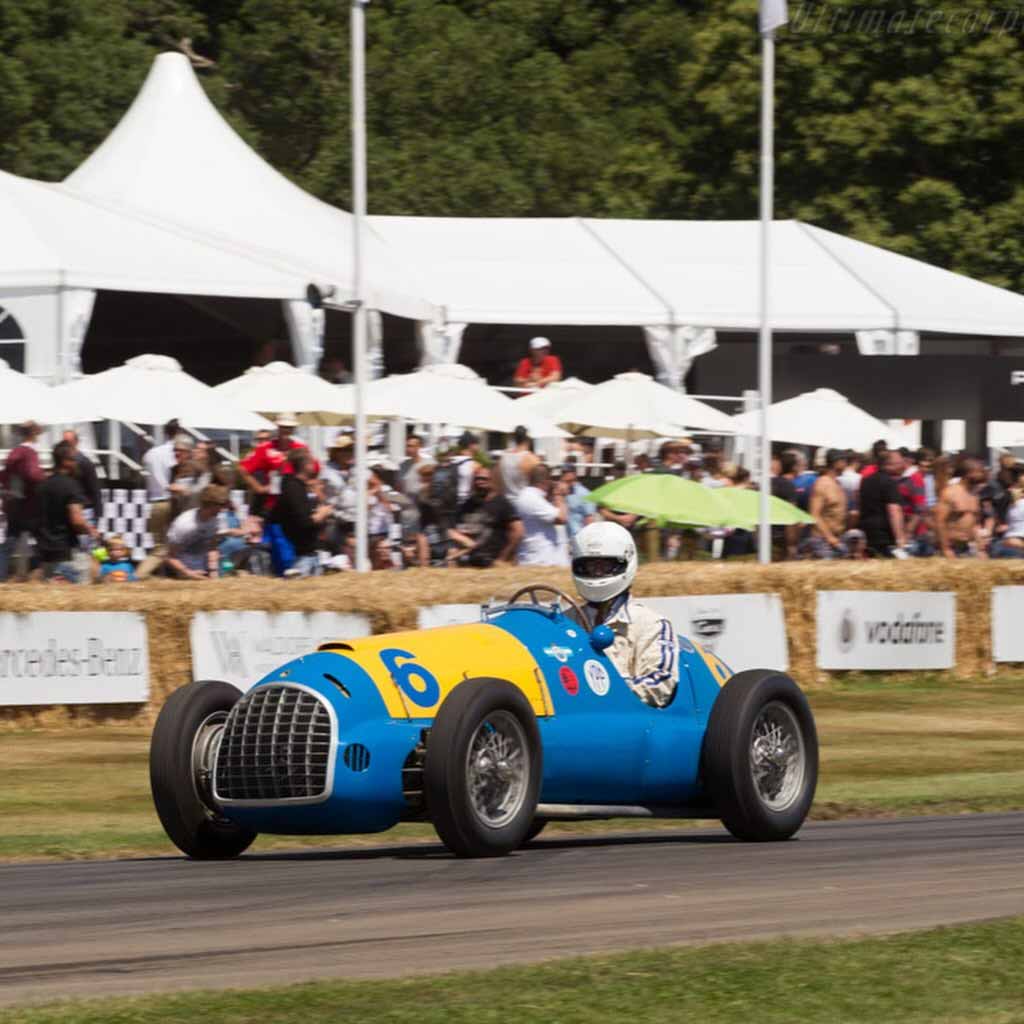
The steering demanded strength, the gearbox demanded accuracy and the brakes required a formal introduction several seconds before the corner. But the FL was not crude in the way a badly designed car is crude. It was direct. Every movement passed through the narrow tyres, leaf springs and exposed chassis without being softened by anything so decadent as comfort. The driver did not operate the machine from a distance; he became one of its moving components.
Formula Libre was precisely the arena for such a creation. Its broad regulations attracted European stars, South American heroes and machinery from several incompatible chapters of the rulebook. Ferrari developed the 166 FL primarily for the Temporada races, where a supercharged two-litre V12 might encounter enormous pre-war Grand Prix cars, newer Maseratis and whatever else had survived the shipping journey. Only three examples were produced between 1949 and 1952, making it less a model range than a particularly energetic argument.

The drivers gave that argument authority. Giuseppe “Nino” Farina won at Rosario in February 1949. Alberto Ascari triumphed at Buenos Aires later that year. Juan Manuel Fangio and José Froilán González then carried the car through a succession of South American victories, including Paraná and Santiago in 1950, Buenos Aires in 1951, and races at Interlagos, Rio de Janeiro and Montevideo in 1952. These were not ceremonial appearances arranged to entertain wealthy spectators. The 166 FL repeatedly defeated opposition from Alfa Romeo, Maserati and Mercedes—companies whose histories were considerably longer than Ferrari’s office stationery.

Chassis 011F captures the car’s wonderfully untidy existence. It began as a normally aspirated Formula 2 machine and won at Monza with Fangio. It was then acquired with Argentine support, repainted in national blue and yellow, fitted with a supercharger and sent into Formula Libre competition. Later it returned to Europe without the blower, then crossed the Atlantic again and became successful with González. Modern manufacturers would describe this as a multi-stage international development programme. Ferrari simply kept modifying the car until it won somewhere else.
The 166 FL reveals Ferrari before Ferrari had learned to behave like an institution. There was no vast mythology to protect, no lifestyle division and no heritage department carefully polishing the past. There was a young company, an adaptable V12 and Enzo’s conviction that a racing car should be useful wherever someone offered prize money. The FL is therefore not merely an early Ferrari; it is Ferrari’s competitive instinct before fame made it ceremonial.
Its driving character must have been equal parts delicacy and threat. The front end was light and immediate, the narrow tyres progressive, and the live rear axle permanently prepared to contribute an opinion. Fangio’s celebrated mechanical sympathy suited it perfectly. He understood that speed was not violence but timing: load the chassis gently, allow it to settle, then use the supercharger’s force without turning the rear tyres into smoke and optimism.

That distinction mattered because Formula Libre encouraged excess. The regulations permitted engineers to become ambitious, and ambitious engineers are responsible for many marvellous things, plus several objects that could only be started while standing behind a wall. The 166 FL had enormous performance but retained enough balance and reliability to translate it into victories rather than merely impressive accidents.
The 166 FL was a violin fitted with a hand grenade.
Today, its collector value is almost inseparable from its provenance. With only three built and histories connected to Fangio, Ascari, Farina and González, a surviving example belongs among the most significant early Ferrari competition cars. Yet rarity is only part of its importance. The FL carried Colombo’s V12 beyond Europe and helped establish Ferrari as an international racing force before the Formula One World Championship had properly settled into its chair.
What it ultimately represents is the young Ferrari’s refusal to specialise. It was a Formula 2 idea supercharged into a Formula Libre weapon, shipped to another continent and entrusted to men who raced with extraordinary finesse in an era of astonishing risk. Elegant, improvised and slightly unreasonable, it proved that Maranello’s future would not be built by waiting for the correct category. Ferrari would build the car first, find the battle second—and usually arrive making far more noise than strictly necessary.


