Ferrari’s 250 Testa Rossa proved that endurance greatness could wear outrageous pontoon fenders, old-school hardware and a V12 tuned for survival.
Ask a collector why this Ferrari matters, and the answer should not begin with an auction catalogue. The 250 Testa Rossa is precious because it contains a marvellous contradiction: it looked like a dare, yet it was engineered with the caution of people who knew 24 hours could make fools of geniuses. Those red-painted cam covers gave it the name, but endurance logic gave it the legend.
The cleanest picture is the 1957–1958 250 TR, especially the Scaglietti-bodied pontoon-fender spider. Later Testa Rossa relatives complicate the family tree, so one must tread carefully before treating every win as the work of one identical car. Still, the original shape is the poster: front wheels almost undressed, bodywork sliced back for brake cooling, and a face only Italy could make seem both practical and theatrical.
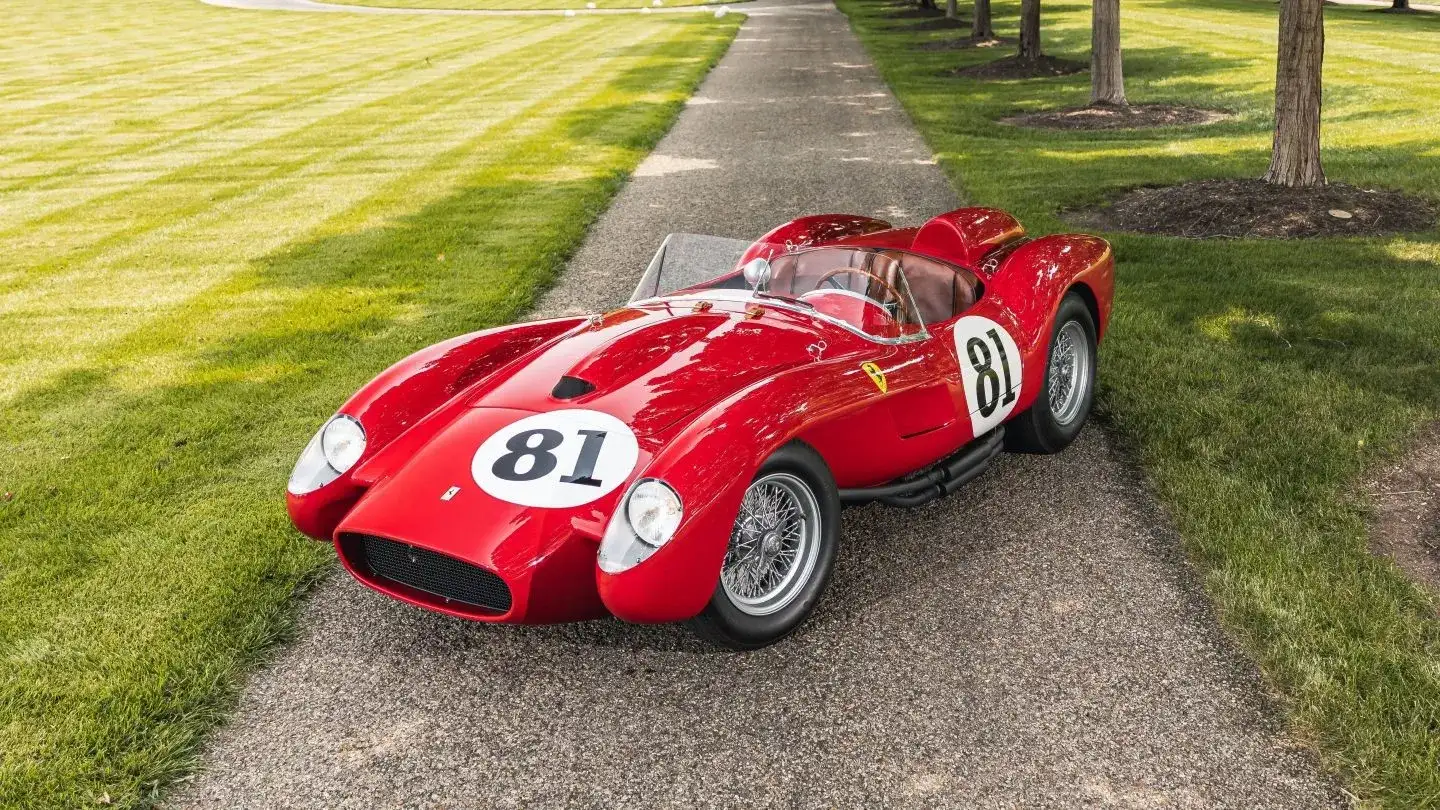
Ferrari did not win here by worshipping novelty. Under the bonnet sat the proven 3.0-litre Colombo-derived V12, chosen for the new three-litre sports-racing world because it could keep working when glamorous alternatives expired in public. Early cars kept drum brakes and a live rear axle, which sounds like arriving at dinner in evening dress and hobnail boots. Yet the combination made sense: light, familiar, serviceable, and fast enough to make modernity look faintly unemployed.
Then came the results, which rather spoiled any argument that it was merely pretty. In 1958, the Testa Rossa family helped Ferrari win Sebring, the Targa Florio and Le Mans. Olivier Gendebien and Phil Hill took Le Mans in 1958; Gendebien returned with Paul Frère in 1960 and with Hill again in 1961 in Testa Rossa-related 250 machinery. Across international championship races from 1958 to 1961, the model line became one of Ferrari’s sharpest instruments.

The human cast is suitably serious. Enzo Ferrari’s choice was not romance but selection: a V12 he trusted, a chassis philosophy adapted for survival, and bodywork shaped by Scaglietti for the brutal housekeeping of heat. Hill, Gendebien, Frère and Richie Ginther were not polishing myths; they were managing hours, traffic, weather and machinery. Chassis histories bring in figures such as John von Neumann and Dr. Frederick Simeone, reminding us that racing cars live several lives after the flags fall.
Its special observation is this: few racing cars have ever made cooling look so vain. The pontoon fenders are often remembered as sculpture, but they were an answer to hot brakes, not a stylist’s lunch-break hallucination. That is the Italian trick at full voltage—solve a problem so dramatically that the rest of the world assumes you were showing off. Signature line: it is not beautiful despite its purpose; it is beautiful because purpose lost its temper.

The regret, of course, is that the 250 Testa Rossa now moves more often through museums, concours lawns and guarded collections than through night rain at Le Mans. But that is a respectful retirement, not a defeat. It represents a moment when Ferrari turned reliability into glamour, when national pride wore red paint without needing to shout, and when an endurance racer could be old-fashioned, outrageous and absolutely right.
Phil Hill — American racing driver; 1961 Formula One World Champion and three-time Le Mans winner


