A ten-car targa masterpiece that wrapped 488-derived V8 engineering in razor-sharp Ferrari futurism, proving heritage works best when designers reinterpret it rather than simply reproduce it.
At the National Art Center in Tokyo in December 2016, Ferrari celebrated fifty years in Japan by unveiling something rather more memorable than a commemorative keyring. Beneath the lights sat the J50: low, roofless, impossibly sharp and looking as though a 488 Spider had disappeared into a design studio and returned wearing an Italian architect’s idea of a samurai helmet.
Created by Ferrari’s Special Projects department and designed at Centro Stile under Flavio Manzoni, the J50 was limited to just ten examples, each individually tailored for a Japanese client. Beneath it lay the proven structure of the 488 Spider, but visually almost nothing was allowed to escape unchanged. Ferrari could simply have fitted different bumpers and called it exclusive. Instead, it redesigned the body almost completely. Occasionally charging extraordinary money produces extraordinary effort.
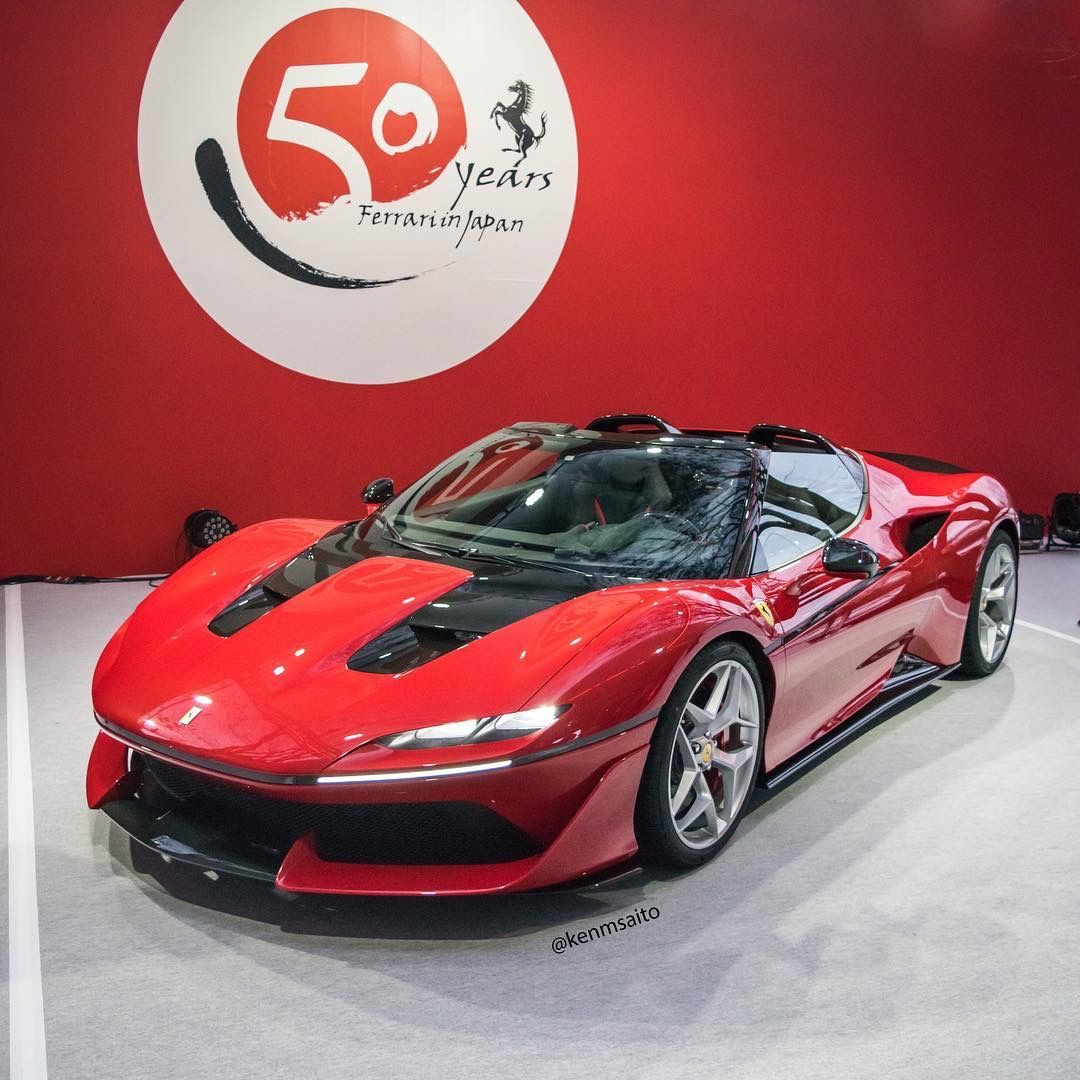
The J50 revived Ferrari’s targa tradition while deliberately recalling the open competition barchettas of the 1950s and the black dividing lines of the GTO, F40 and F50. Yet it never became retro. A dark blade rises from the nose, cuts through the flanks and disappears into the side intake, visually lowering the entire car. Above it, the windscreen and side glass form a visor-like canopy. The result is remarkable: the J50 appears lower than a 488 even while standing still, as if gravity has developed a preference for Italian design.
The bonnet dips between pronounced wheelarches, twin carbon-fibre channels carve through the front surface and extraordinarily thin LED lamps remove almost all visual weight from the nose. At the rear, a transparent polycarbonate engine cover flows into separate roll hoops, joined by an aerofoil inspired by Ferrari sports prototypes of the 1960s. Four circular taillights return because, apparently, even futurism occasionally knows when the old Italians were right.
And then there is the rear diffuser, shaped with the visual aggression of a jet afterburner. Ordinarily that description would be marketing nonsense involving men pointing at fighter aircraft during PowerPoint presentations. On the J50, it actually looks justified.

Underneath sits Ferrari’s 3,902 cc twin-turbo V8, specially tuned to 690 cv — 20 cv more than the contemporary 488 Spider — driving the rear wheels through a seven-speed dual-clutch transmission. Ferrari never made the J50 about stopwatch statistics, and official J50-specific acceleration and maximum-speed figures were not published. That seems almost civilised. When only ten cars exist, arguing about tenths at the pub becomes unnecessarily optimistic.
Aerodynamics received genuine attention rather than merely decorative holes. The radiators were moved closer together, the front bumper was completely reconsidered and the windscreen header lowered to improve airflow toward the rear aerofoil. This is the important thing about the J50: its beauty was not applied after the engineering. The engineering became the beauty.
That may explain why the Red Dot jury awarded it Best of the Best in Product Design 2017, praising its balance of strength, elegance and visual lightness. It was Ferrari’s third consecutive year taking the award’s highest distinction. Looking at the J50, the achievement feels deserved rather than ceremonial.
The original Tokyo car appeared in a special three-layer red with a red-and-black leather and Alcantara interior. Remove its two-piece carbon-fibre targa roof and the whole composition becomes even more convincing. Nothing appears merely chopped off. The flying surfaces, hoops and transparent engine cover make the open cockpit feel fundamental to the design.
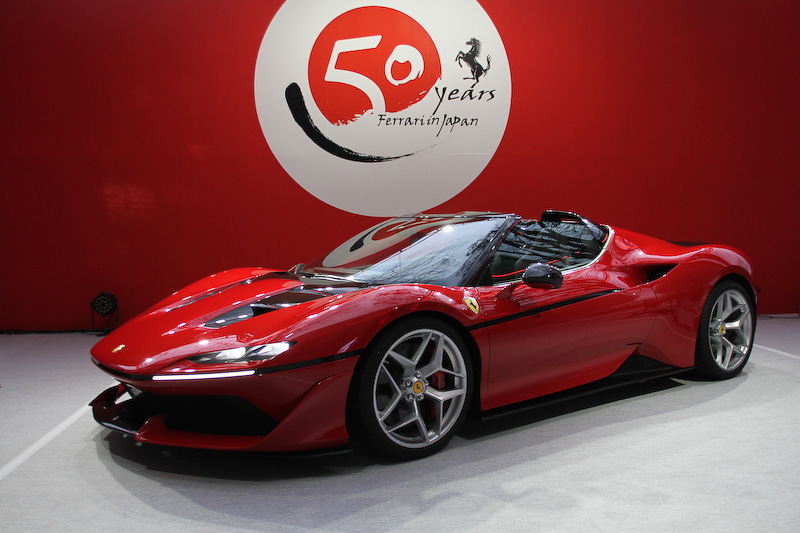
The J50 is the rare Ferrari whose most powerful component may be the line drawn along its side. That is its Signature Line. The black slash changes the perceived height, ties several generations of Ferrari together and gives a mechanically familiar platform an entirely different personality.
Only ten were made, ensuring collector importance almost before the champagne glasses in Tokyo had been cleared away. But scarcity alone is boring; manufacturers can manufacture rarity remarkably easily. The J50 matters because its exclusivity came with genuine design ambition.

Ultimately, the Ferrari J50 represents what happens when heritage is treated as vocabulary rather than costume. It remembers the barchettas, the GTO, F40 and F50 without imitating any of them. Underneath is a magnificent 488-derived machine. Above it is something rarer: proof that when Ferrari’s designers are given freedom, even a familiar supercar can become sculpture.


