Brian O’Conner’s R34 became a screen icon, but its story spans different films, different cars and a remarkable Nissan performance family.
Why pull the bodywork in so close to the wheels, only to cover the car in stripes that make it impossible to overlook? The R34 GT-R’s short front and rear overhangs give it a compact, concentrated stance; Brian O’Conner’s silver-and-blue film colours then make that shape conspicuous. One choice belongs to Nissan, the other to cinema. Somehow, neither cancels the other out.
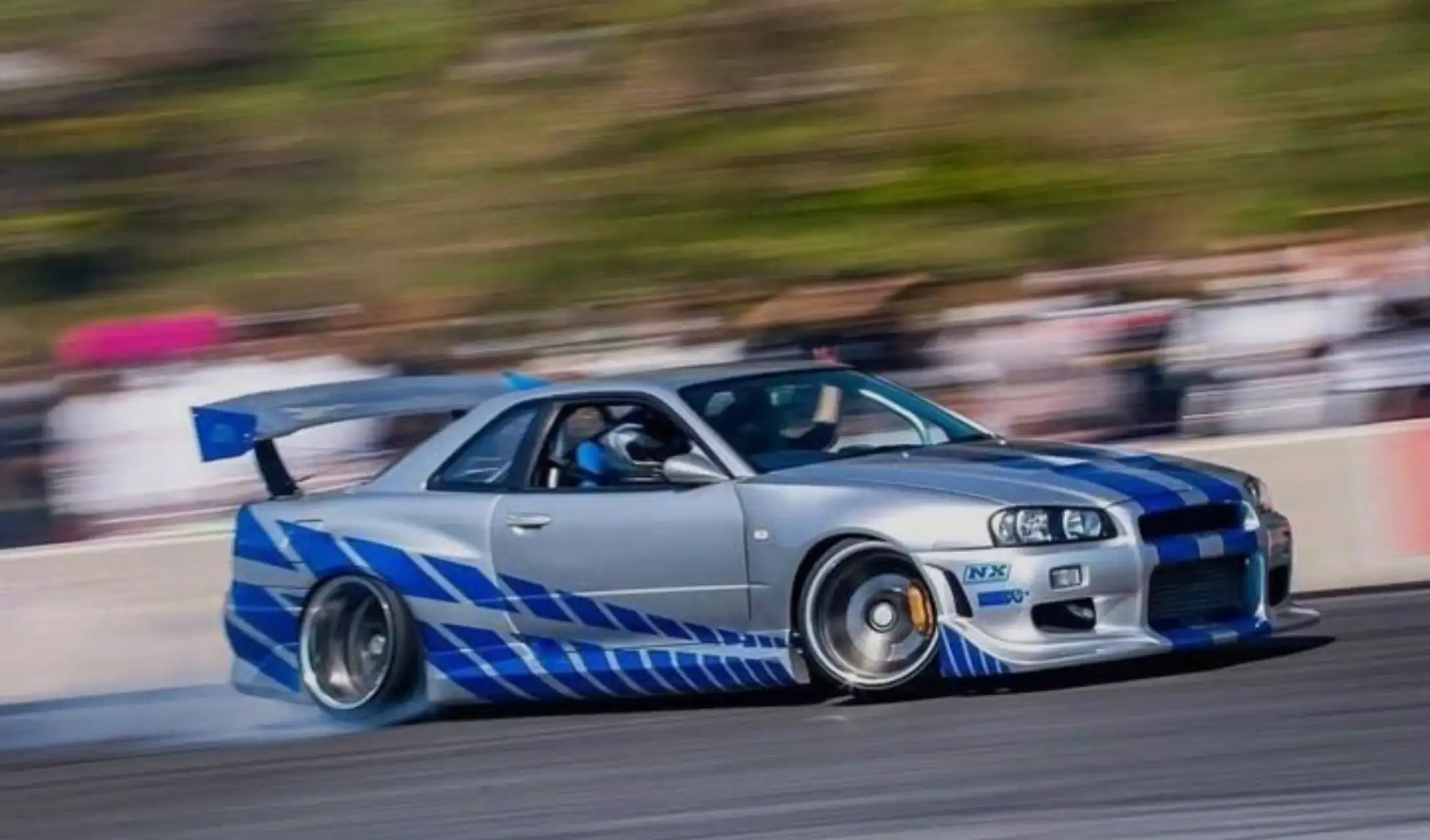
The proportions suggest a car drawn around its mechanical business rather than around a fashion for long, sweeping ends. Nissan did shorten the overhangs, but the shape alone cannot tell us precisely how much of that decision was made for handling, packaging or appearance. What can be seen is the result: a muscular coupé with very little visual slack. The blue graphics have a disciplined shape to work with, even if discretion was plainly not on their brief.
That combination belongs to Brian’s R34 in 2003’s 2 Fast 2 Furious, where Paul Walker plays O’Conner. Silver gives the car a relatively cool base; the blue markings make it a character in its own right. The interesting contrast is that the decoration does not need to create aggression from nothing. It sits on a silhouette that already looks purposeful, turning a Nissan performance car into something a film audience can recognise at a glance. Beneath the broader image is a road car with its own identity. Nissan introduced the BNR34 Skyline GT-R in 1999, with the RB26DETT twin-turbocharged straight-six, a six-speed manual gearbox and all-wheel drive. Its officially quoted 280 PS was a figure for the production car, not a reliable description of an unidentified film vehicle. The engineering gives the shape context; the graphics give it a second vocabulary.
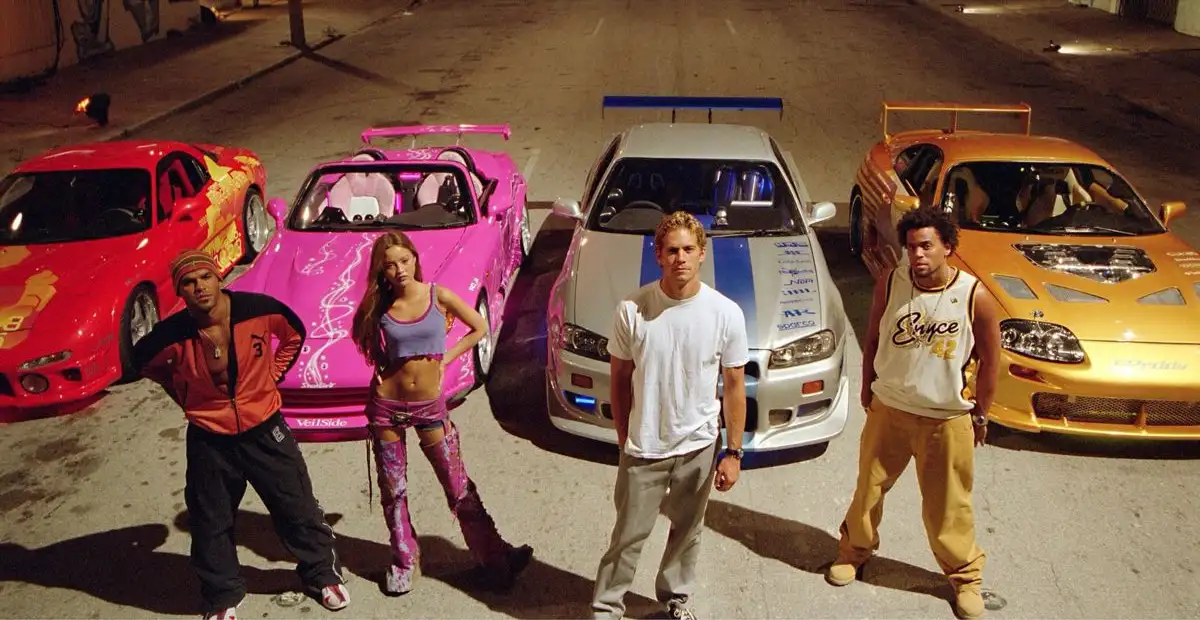
There is a useful distinction here between recognising a screen look and identifying an individual car. Silver paint and blue stripes point to this particular film portrayal, but they cannot establish a chassis number, the mechanical specification or which vehicle performed a given piece of filming. A faithful recreation can capture the first of those things without proving any of the others. Collectors may require documents; the rest of us are allowed to enjoy the view while they find them.
Even Nissan’s own R34 variants deserve separate treatment. The later V-spec II had a carbon-fibre bonnet with a NACA duct, a detail specific enough to be worth checking rather than assuming. It would be easy to assemble the most desirable features from every GT-R and call the result Brian’s car. That would make a splendid pub argument, though a less satisfactory piece of identification. The film’s visual identity is more certain than the particulars beneath it.
That is what makes this R34 more interesting than a performance car simply made famous by a film. Its measured, compact form and its unabashed blue-on-silver costume tell two different stories at once, and both remain legible. The car wears its engineering seriously and its fame rather less quietly. Brian’s Skyline represents the meeting of those two worlds: a machine with a life on the road and an image that belongs to popular memory.


