A championship Porsche with the engineering of Weissach and the grin of something escaping Jurassic Park.
At Sebring in March 2023, a bright green Porsche rolled into the paddock wearing teeth across its front bumper and tiny forearms on its doors. It looked like a Tyrannosaurus rex that had acquired carbon fibre, slicks and a competition licence. The joke should have lasted one weekend. Instead, “Rexy” became an endurance-racing icon.
AO Racing had entered IMSA only weeks earlier with founders PJ Hyett and Gunnar Jeannette. Their number 80 Porsche 911 GT3 R first appeared at Daytona in a retro tribute livery, but Sebring introduced the dinosaur. The design grew from cartoon creatures Hyett had placed on his helmet to entertain his children. Green bodywork became skin, the nose a row of teeth and the rear wing a tail. Marketing departments spend months inventing identities. AO Racing drew a dinosaur and conquered the grandstands.
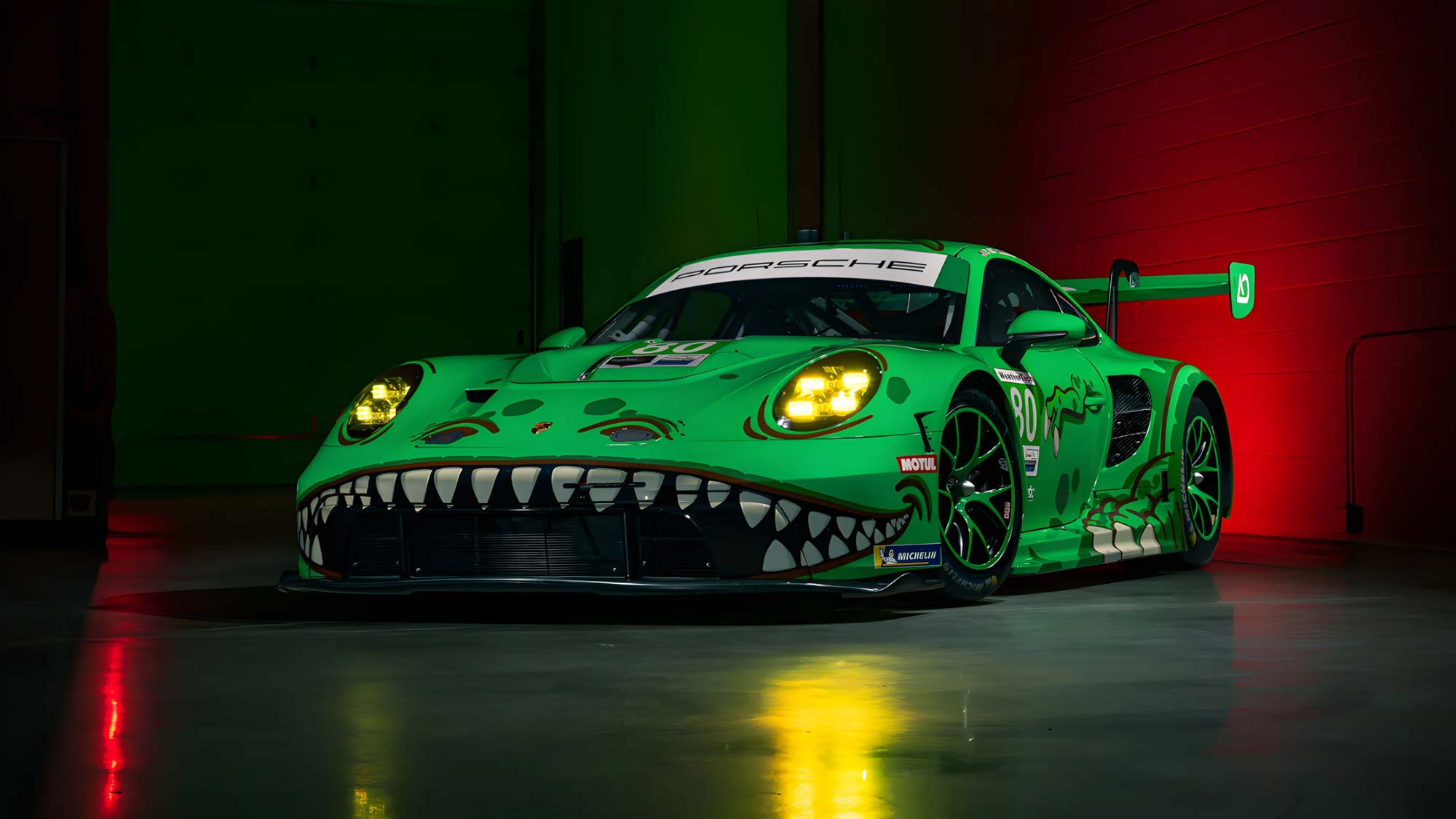
Beneath the comedy was Weissach’s very serious 992-generation 911 GT3 R. Development began in 2019, targeting easier operation, broader BoP reserves and a car professionals and gentleman drivers could keep fast over long stints. It debuted for 2023 with the familiar 911 idea—engine behind driver, faith ahead of him—refined into a sophisticated customer racer.
Its naturally aspirated 4,194 cc flat-six produces up to Approx. 565 PS before series-specific restrictions intervene. It revs to 9,250 rpm and drives the rear wheels through a six-speed sequential gearbox. Porsche tilted the engine forward by 5.5 degrees to create more room for the underfloor diffuser, then moved auxiliary components forwards and down to improve balance. Even the air-conditioning compressor received strategic redeployment, which is how one knows German engineers have become emotionally involved.

The aluminium-steel structure echoes the road-going 992, though nearly every visible panel is carbon fibre and the wheel arches are aramid. Double-wishbone front suspension replaces the road car’s struts, while the multilink rear arrangement, KW dampers and enormous AP brakes are built for adjustment and endurance. At Approx. 1,250 kg before BoP ballast, Rexy is lighter than it looks, which is more than can be said for most dinosaurs.

A raised front underbody, long diffuser and swan-neck wing generate stable downforce rather than one heroic qualifying number. That matters in IMSA, where the car must remain predictable through traffic, fading tyres and drivers who eventually communicate mainly through breathing.
Rexy’s first 2023 campaign in GTD brought affection faster than trophies. Hyett and Sebastian Priaulx showed pace, but the number 80 ended the season without a podium. Popularity arrived anyway. Children queued for photographs, adults bought dinosaur merchandise without shame, and the paddock gained a character rather than another sponsor arrangement.

For 2024, AO moved Rexy into GTD Pro and changed its number to 77. Priaulx was joined by Laurin Heinrich, with factory specialists appearing for endurance rounds. The silliness remained outside; underneath, the operation became ruthlessly effective. Rexy took its first IMSA victory at Laguna Seca, won again in Detroit and Indianapolis, and helped AO Racing claim the teams’ championship, Heinrich the drivers’ title and Porsche the manufacturers’ crown. A cartoon tyrannosaur had become a proper champion.
The livery evolved with the racing. Damage brought bandages, missing teeth or braces to Rexy’s face, turning repairs into storytelling. Pink sibling “Roxy” and purple dragon “Spike” followed, but Rexy remained the original. Most liveries conceal machinery beneath sponsorship; Rexy turned a season into a character arc.

Driving it still demands respect. The rear engine provides formidable traction and braking stability, while the enlarged flat-six offers a broader torque curve than its predecessor. Yet a 911 GT3 R remains alive beneath the driver: precise on entry, muscular on exit and happiest when weight transfer is handled cleanly rather than negotiated by panic. Its roar is not cute. At full revs, the dinosaur abandons children’s television and starts rearranging pit-wall furniture.
Rexy’s value lies in provenance rather than rarity: the number 80 debut, the first victory and the 2024 championship. Porsche later commissioned a road-going GT3 RS tribute through Sonderwunsch, proof that the joke had travelled back to Stuttgart.
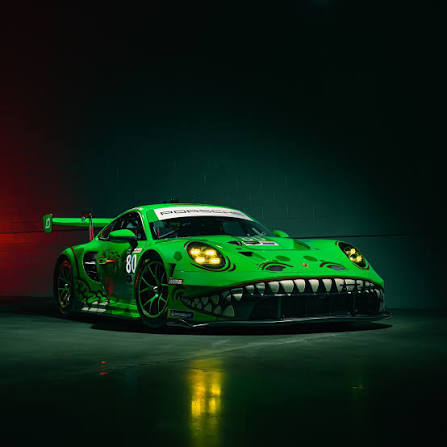
The Signature Line is this: Rexy gave endurance racing a face—and then filled it with teeth.
Ultimately, the green 911 represents something increasingly rare in professional motorsport: seriousness without self-importance. The engineering is Porsche, the execution championship-grade and the livery gloriously ridiculous. Rexy did not make GT racing less credible. It reminded everyone why credibility matters more when people are watching.


