Toyota's late A80 Supra GT500 paired an unmistakable silhouette with V8 racing hardware, capturing Japanese GT competition's ability to turn familiar road-car shapes into uncompromising circuit machines.
Red paint, a vast rear wing and a toy-company name stretched across the doors: the BANDAI Supra looks like something built to escape its own display cabinet. Look closer and the proportions become less playful. The nose lies low, the body spreads over the wheels, and the familiar A80 roofline survives above a very serious racing machine.

This is the world of KRAFT's number 34 Supra in the 2005 SUPER GT season, shared by Seiji Ara and Naoki Yokomizo. Its name belongs to a road-car legend, but the race programme had priorities beyond keeping the showroom specification intact. Recognition mattered; mechanical sentimentality was not going to improve a lap time.
The engine is the revealing detail. KRAFT's official specification lists a 4,480 cc 3UZ-FE V8 producing 480 PS at 7,600 rpm, prepared by Toyota Techno Craft. That is not the celebrated straight-six so closely associated with the road-going A80. The silhouette kept the family resemblance while the engine department quietly rearranged the family tree.
A six-speed sequential transmission, double-wishbone suspension and a listed weight of 1,090 kg complete the outline. These are the team's published figures, not a promise that every race configuration weighed exactly the same. Racing cars have a habit of making tidy specification tables untidy, usually just when somebody has finished printing them.
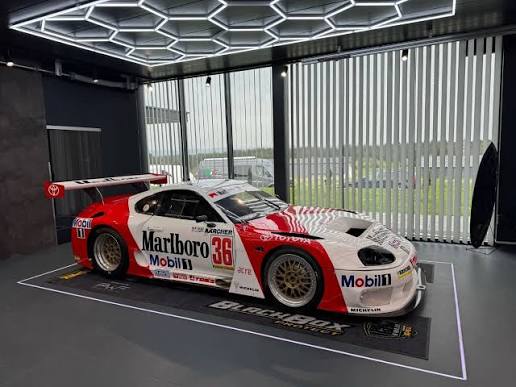
The fascination lies in that distance between image and purpose. This Supra remains instantly readable as an A80, yet its huge wing, low front aero and visible cockpit cage announce a different set of responsibilities. The sponsor graphics provide colour and character; the machinery underneath has rather less interest in being charming.
Its career belongs to a longer story. Toyota records the JZA80's top-class Japanese GT campaign from 1994 through 2006, with four drivers' championships. A shape born in the early 1990s remained relevant against newer rivals because the racing version kept evolving. Retirement, evidently, required more than somebody unveiling a newer brochure.
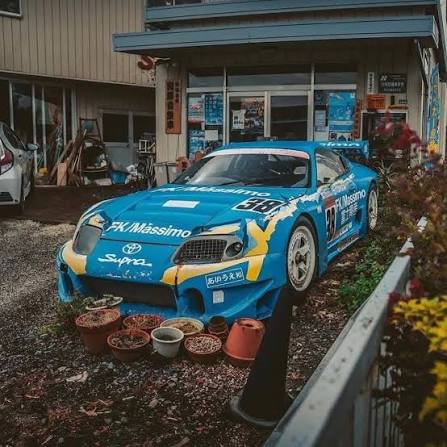
In 2005, the title went to another Supra: the ZENT CERUMO car of Yuji Tachikawa and Toranosuke Takagi, victorious in the wet Suzuka finale. That success belongs to their entry, not to this red number 34. Keeping the distinction matters. A racing livery is a team's identity, not a transferable receipt for every trophy won by the badge.
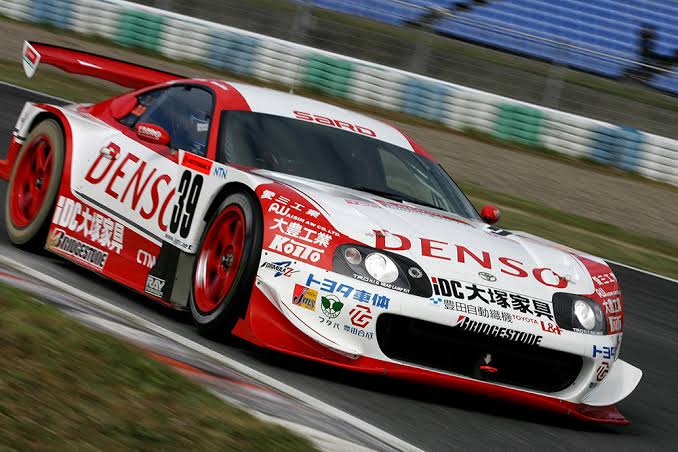
The BANDAI Supra wore a toy-maker's name and a working racer's priorities. It captures an era when Japanese GT racing could transform a recognisable coupe into something much stranger without losing its face. Its lasting appeal is that tension: the car you knew from the street, stretched into the car the circuit demanded. Familiarity brought you closer; the engineering gave you a reason to stay.
-
-


